First screen, captured .
Looks similar
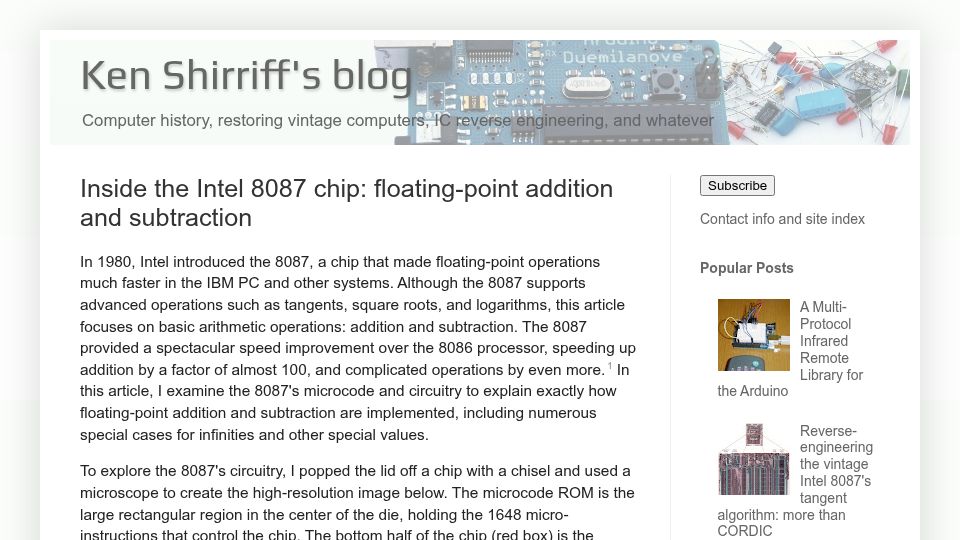
The Intel 8087 chip: floating-point addition and subtraction(righto.com)
102 points by pwg | 33 comments
Ken Shirriff blog post examining the Intel 8087 coprocessor's microcode and circuitry for floating-point addition and subtraction, including special cases.
Related stories
The Intel 8087 chip: floating-point addition and subtraction(righto.com)
102 points by pwg | 33 comments
Ken Shirriff blog post examining the Intel 8087 coprocessor's microcode and circuitry for floating-point addition and subtraction, including special cases.
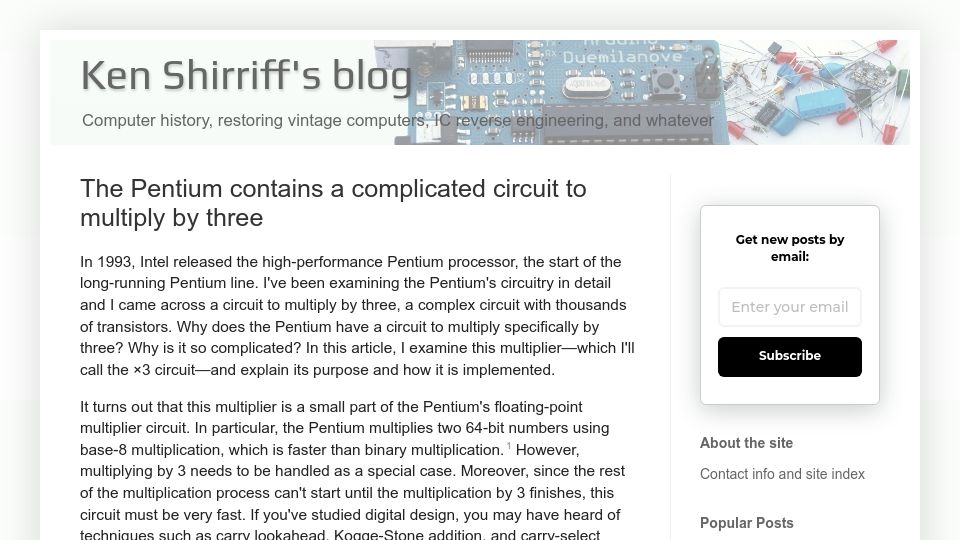
The Pentium contains a complicated circuit to multiply by three(righto.com)
354 points by Tomte | 138 comments
Ken Shirriff's blog post reverse-engineering the Pentium's ×3 multiplier circuit, used in its base-8 floating-point multiplication, and explaining how it works.
That's not an abstraction, that's a layer of indirection(fhur.me)
546 points by fagnerbrack | 213 comments
A blog post arguing that many so-called abstractions in codebases are merely layers of indirection that add complexity and hurt performance without real value.

The new skill in AI is not prompting, it's context engineering(philschmid.de)
832 points by robotswantdata | 467 comments
Blog post by Philipp Schmid arguing that context engineering, supplying LLMs with the right information and tools, matters more than prompting for AI agents.
Intel's $475M error: the silicon behind the Pentium division bug(righto.com)
362 points by gslin | 110 comments
Ken Shirriff's blog post examining the Pentium die to show where the 1994 floating-point division bug lies in the silicon and why it occurred.

I don't like NumPy(dynomight.net)
399 points by MinimalAction | 164 comments
A Dynomight blog essay critiquing NumPy's design, arguing its array broadcasting and indexing make complex computations confusing.