First screen, captured .
Looks similar


Researchers design wearable tech that can sense glucose levels more accurately(uwaterloo.ca)
358 points by ndrwnaguib | 145 comments
University of Waterloo news release about researchers developing a needle-free wrist-worn device that tracks blood glucose levels more accurately.


Octopuses, crabs and lobsters recognised as sentient beings under UK law (2021)(lse.ac.uk)
429 points by bookofjoe | 388 comments
LSE news release from November 2021 announcing that octopuses, crabs and lobsters will be recognised as sentient beings under UK law following an LSE report.

Related stories
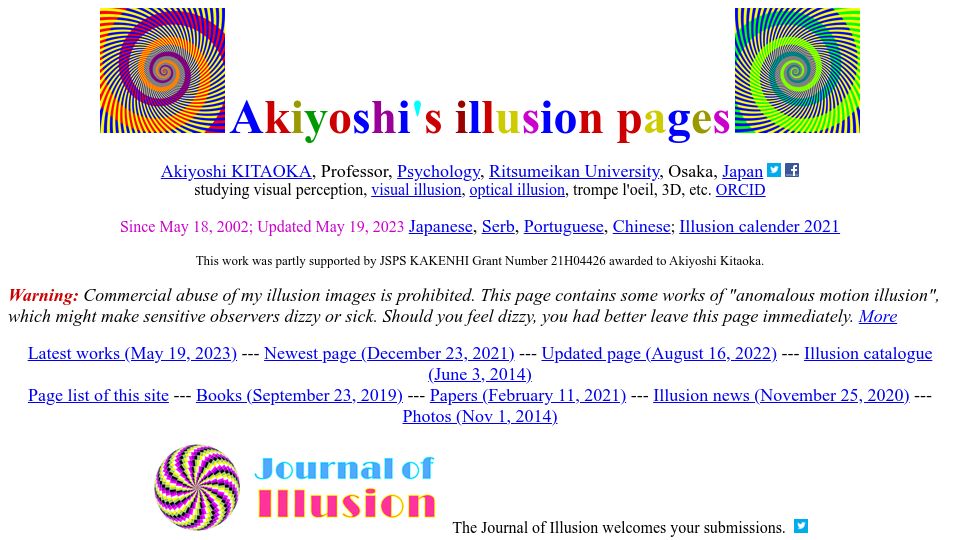
Akiyoshi’s Illusion Pages(ritsumei.ac.jp)
354 points by robin_reala | 56 comments
Personal website of Ritsumeikan University psychology professor Akiyoshi Kitaoka showcasing his optical and anomalous motion illusion artworks and research.
Hallucinations in code are the least dangerous form of LLM mistakes(simonwillison.net)
339 points by ulrischa | 264 comments
Simon Willison blog post arguing that LLM hallucinations in code are the least harmful kind of mistake because running the code exposes them immediately.

LLMs use a surprisingly simple mechanism to retrieve some stored knowledge(news.mit.edu)
336 points by CharlesW | 121 comments
MIT News article on research showing LLMs often retrieve stored facts via simple linear functions, and a technique to probe what a model knows about subjects.

Experts explore new mushroom which causes fairytale-like hallucinations(nhmu.utah.edu)
438 points by astronads | 263 comments
Natural History Museum of Utah article on a newly identified hallucinogenic mushroom from Yunnan markets, known locally as Jian shou qing, that causes fairytale-like visions.
Cold-blooded software(dubroy.com)
499 points by arbesman | 198 comments
Patrick Dubroy's blog essay using cold-blooded animals as a metaphor for software that can sit untouched for long periods and still work when revived.
Something weird is happening with LLMs and chess(dynomight.substack.com)
626 points by crescit_eundo | 424 comments
A Dynomight newsletter post examining how well large language models play chess and why results vary strangely across models.