

First screen, captured .
Looks similar


Related stories

Better Call GPT: Comparing large language models against lawyers [pdf](arxiv.org)
347 points by vinnyglennon | 236 comments
arXiv paper comparing large language models with junior lawyers and legal process outsourcers on contract review accuracy, speed, and cost.

Quantum information spreading via higher-order operator correlators(arxiv.org)
10 points by northlondoner | 0 comments
arXiv preprint introducing N-Operator Correlators, a generalization of out-of-time-ordered correlators for measuring quantum information spreading, with toy-model examples.
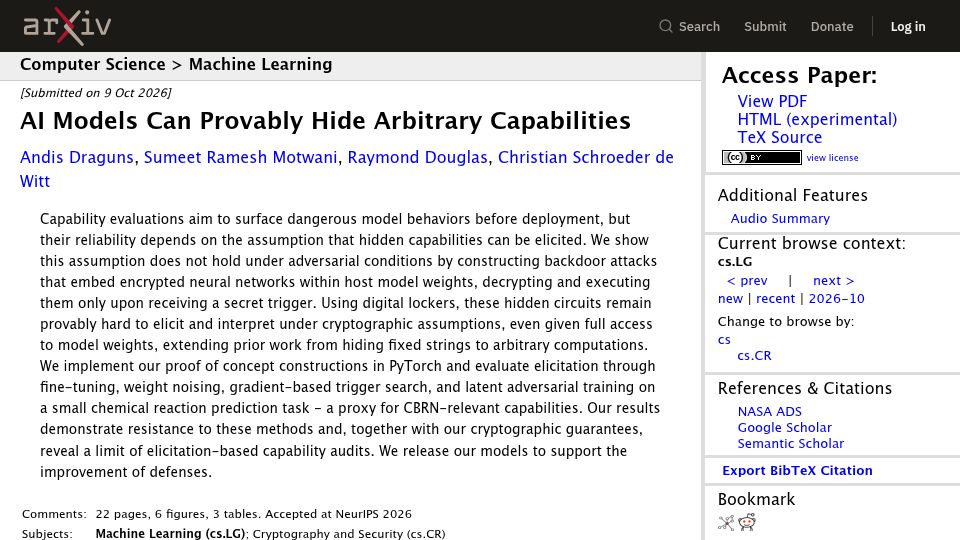
AI models can provably hide arbitrary capabilities(arxiv.org)
252 points by sbulaev | 118 comments
An arXiv paper showing AI models can embed encrypted neural network backdoors that provably hide arbitrary capabilities from elicitation-based safety evaluations.

The Era of 1-bit LLMs: ternary parameters for cost-effective computing(arxiv.org)
962 points by fgfm | 419 comments
arXiv paper introducing BitNet b1.58, a ternary-weight (-1, 0, 1) LLM matching full-precision Transformers while being far cheaper in latency, memory, and energy.
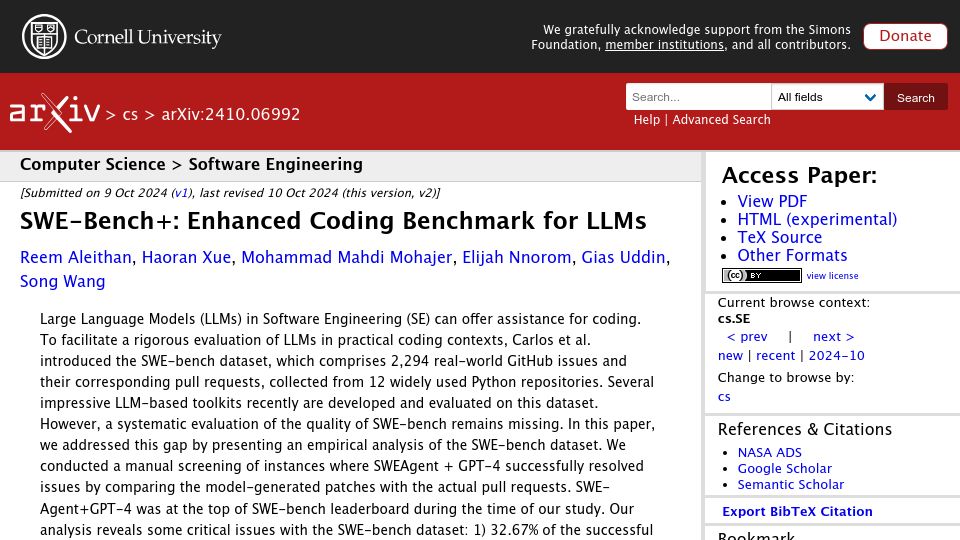
Some critical issues with the SWE-bench dataset(arxiv.org)
331 points by joshwa | 113 comments
arXiv paper introducing SWE-Bench+, an empirical analysis revealing data quality issues in the SWE-bench coding benchmark for LLMs, such as solution leakage and weak tests.

How is a binary executable organized? Let's explore it (2014)(jvns.ca)
445 points by tripdout | 74 comments
Julia Evans blog post from 2014 explaining how ELF binary executables on Linux are structured, using simple tools on a compiled C hello-world program.