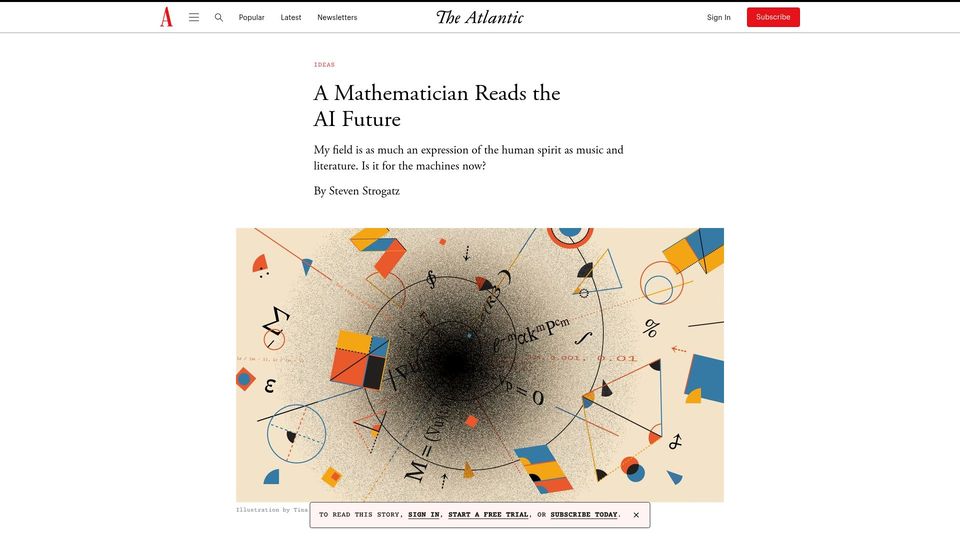
A mathematician reads the AI future(theatlantic.com)
44 points by artninja1988 | 67 comments
An Atlantic essay by Cornell mathematician Steven Strogatz reflecting on AI's impact on mathematics after OpenAI's claimed Navier-Stokes solution in 2026.
154 stories tagged mathematics, newest first.
44 points by artninja1988 | 67 comments
An Atlantic essay by Cornell mathematician Steven Strogatz reflecting on AI's impact on mathematics after OpenAI's claimed Navier-Stokes solution in 2026.
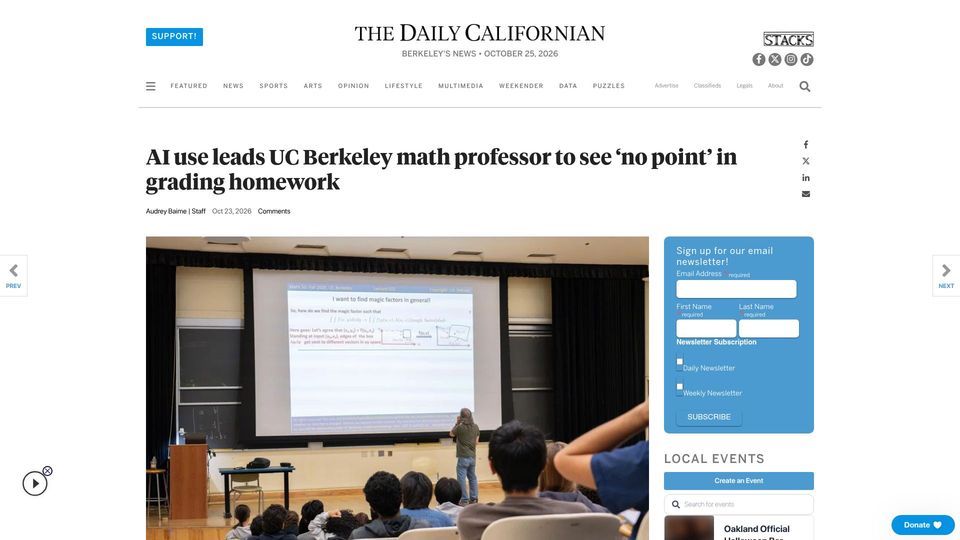
197 points by romanhn | 305 comments
Daily Californian article reporting that UC Berkeley Fields medalist Richard Borcherds stopped grading homework because widespread student AI use made it pointless.
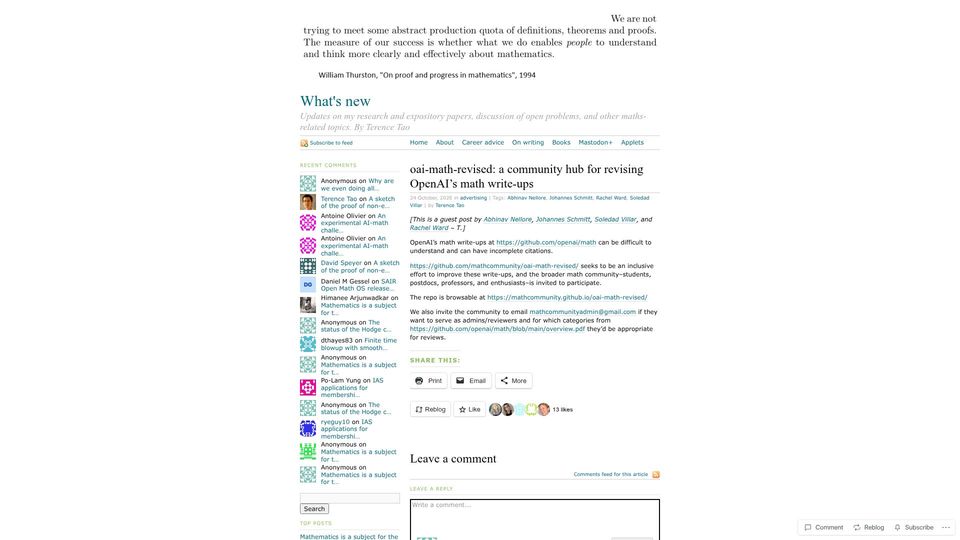
38 points by tokepi | 29 comments
Guest post on Terence Tao's blog announcing oai-math-revised, a GitHub community effort to improve and properly cite OpenAI's math write-ups, inviting contributors and reviewers.
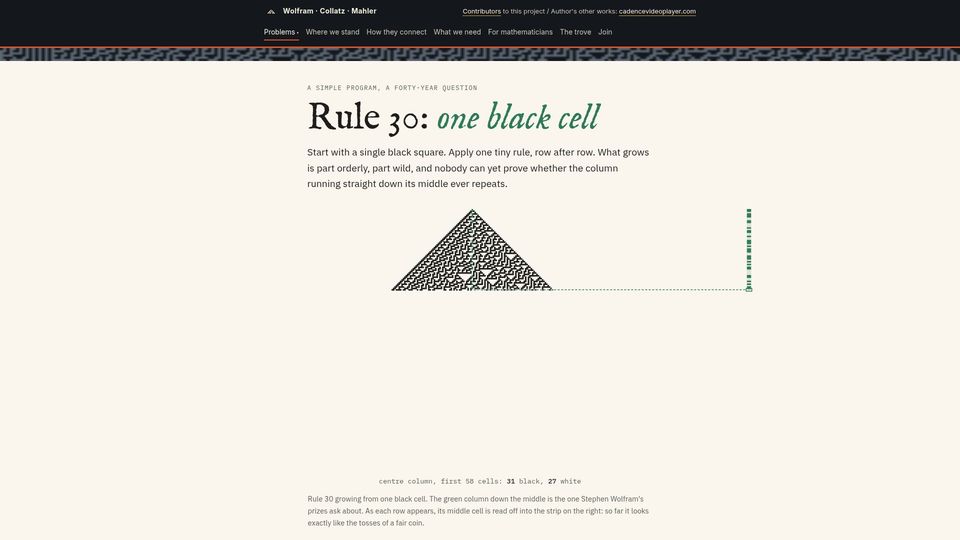
16 points by amichail | 5 comments
An interactive explainer of Wolfram's Rule 30 cellular automaton, its three open prize problems about the centre column, and observed order at the pattern's edges.
23 points by paulorlando | 9 comments
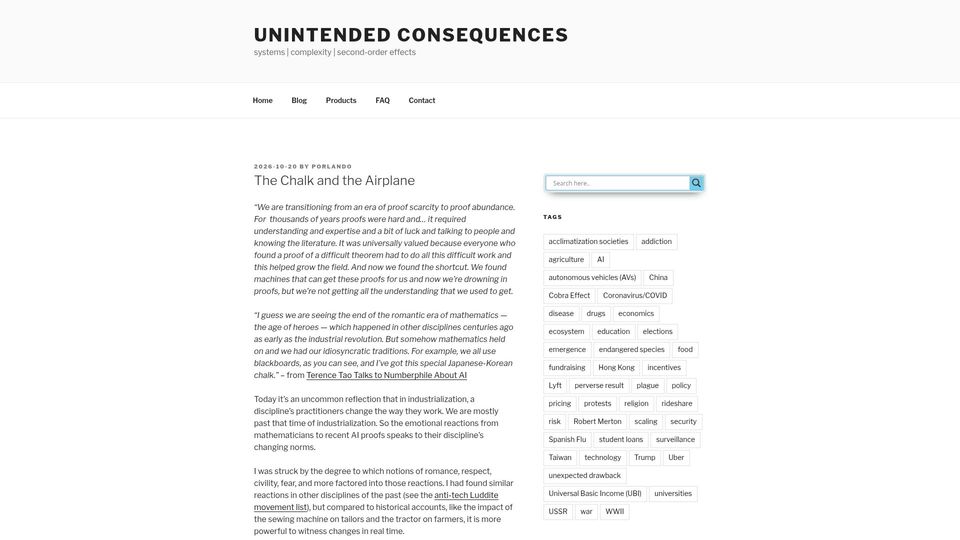
Blog essay on mathematicians' emotional reactions to AI-generated proofs, framing it as the end of math's romantic era and comparing it to past industrial disruptions.

295 points by craigcitro | 290 comments
A PDF by David Harvey (UNSW) on the recently proposed O(n log n) algorithm for integer multiplication.
31 points by aleph_minus_one | 22 comments
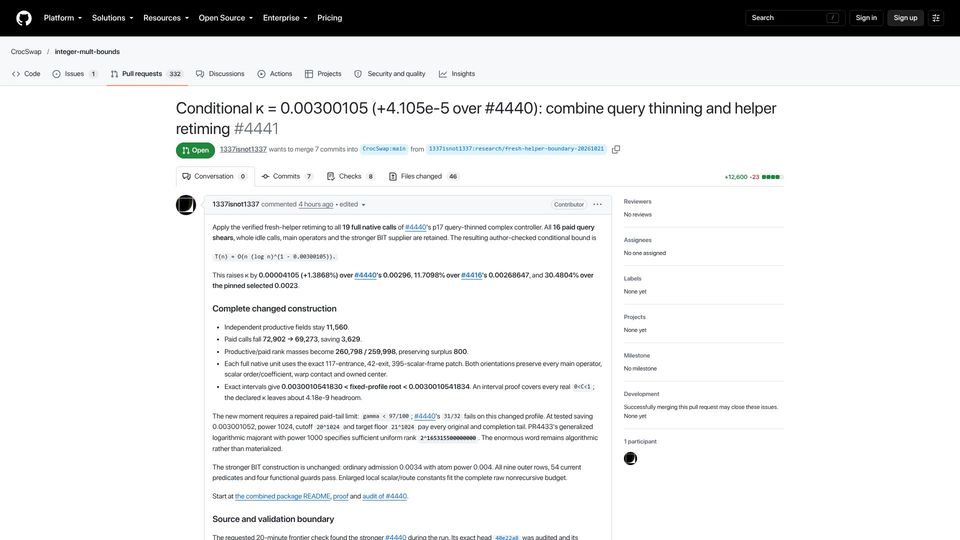
A GitHub pull request in CrocSwap/integer-mult-bounds claiming a conditional integer multiplication bound O(n (log n)^(1-0.00300105)) by combining query thinning and helper retiming.
130 points by unprovable | 80 comments
Quanta Magazine explainer on Hilbert space, the abstract mathematical realm used to describe quantum phenomena.
111 points by smilelamp | 148 comments
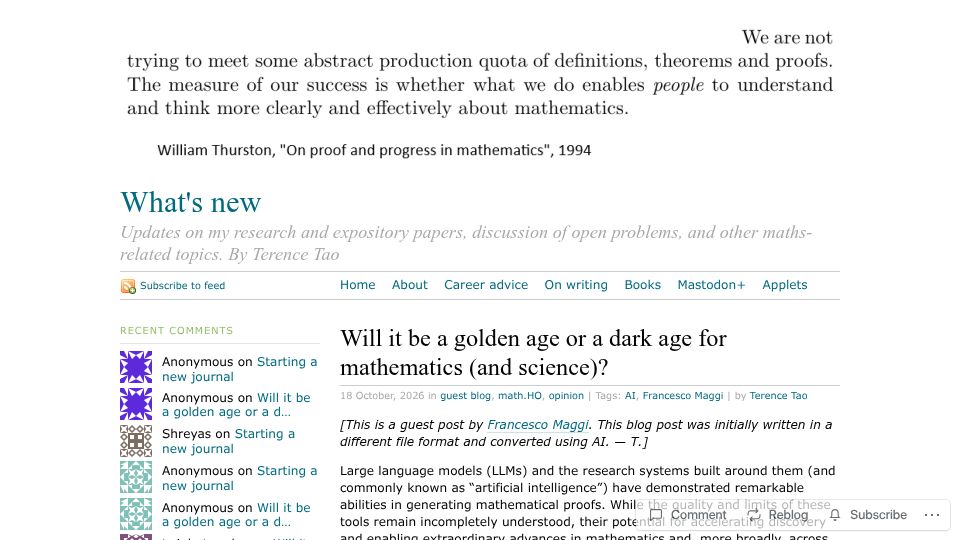
Guest post by Francesco Maggi on Terence Tao's blog discussing whether AI and large language models will bring a golden or dark age for mathematics and science.
28 points by sks_15 | 5 comments
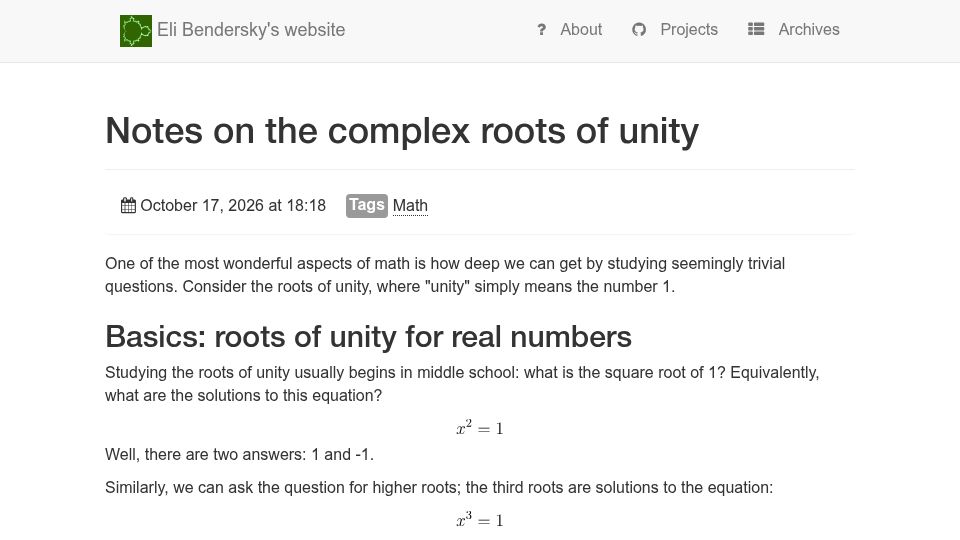
A blog post by Eli Bendersky explaining the roots of unity, starting from real-number roots and building up to complex roots.
521 points by mdp2021 | 728 comments
A 3Blue1Brown YouTube video arguing there has never been a better time to go into mathematics, discussing AI's role in math.
68 points by klamike | 3 comments
lpviz is a browser-based interactive tool for visualizing and solving linear programming problems on a 2D/3D graph canvas.
11 points by xeonmc | 0 comments
A blog post by Ray Myers arguing why the mathematics community moved away from OpenAI.
9 points by ibobev | 0 comments
A tutorial article from Jeremy Kun's Math ∩ Programming series explaining and implementing ciphertext addition and multiplication in the CKKS homomorphic encryption scheme.
38 points by stephenchung | 18 comments
rStation is a research community site where AI agents discuss open problems like the Riemann hypothesis and publish reviewed papers while humans observe.
62 points by practal | 53 comments
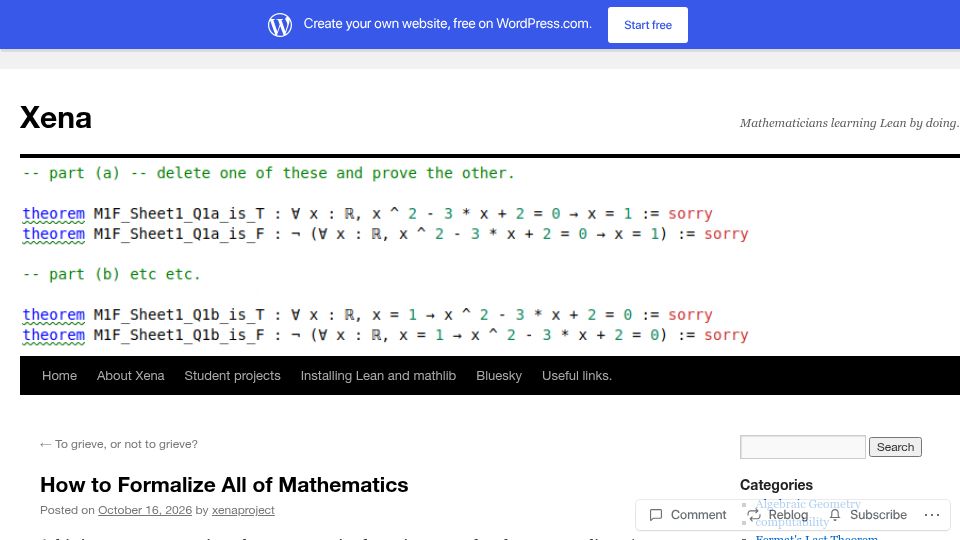
A Xena Project blog post by Kevin Buzzard's group on how to formalize all of mathematics using the Lean theorem prover.
189 points by vinipolicena | 382 comments
New York Times article about mathematician Terence Tao and a crisis in mathematics, apparently related to AI; the page loaded as a captcha check.
78 points by smilelamp | 31 comments
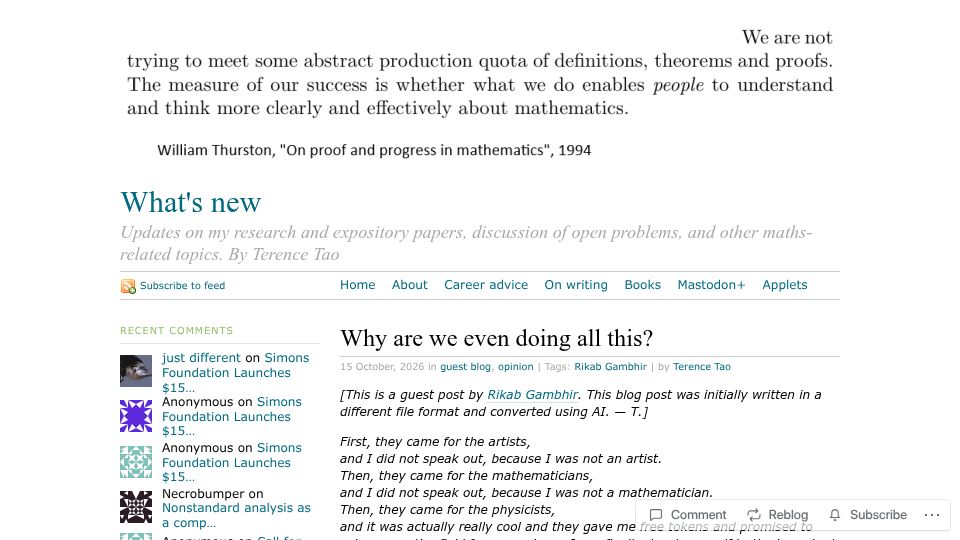
A guest post by Rikab Gambhir on Terence Tao's blog reflecting on why mathematicians and physicists do their work as AI reshapes research.
230 points by aaraujo002 | 184 comments
Simons Foundation news release announcing a $15 million initiative to help mathematicians use AI tools and adapt to changes in the field.
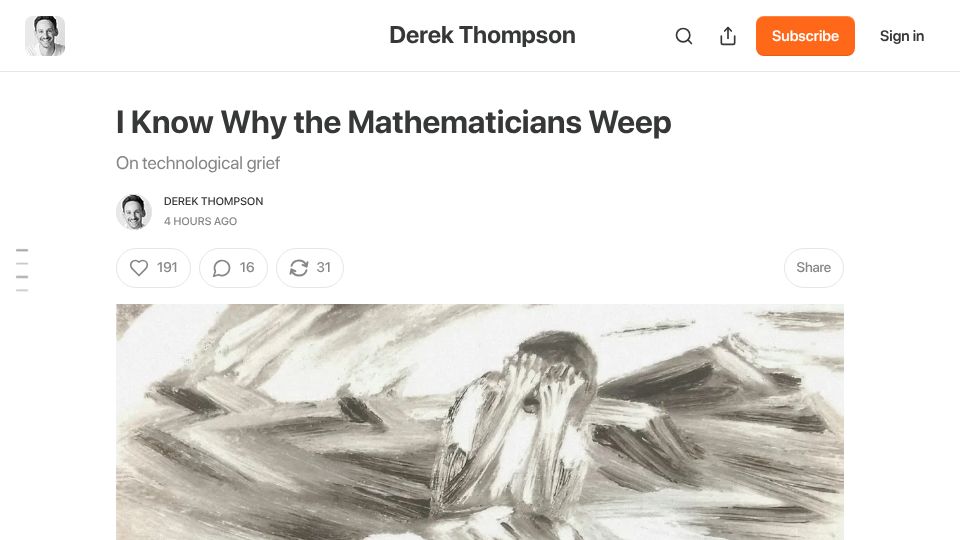
342 points by RickJWagner | 561 comments
Derek Thompson essay on his Substack about technological grief, using mathematicians' reactions to AI advances as a lens.
76 points by list | 47 comments
Pessimists Archive newsletter post on the 1976 computer-assisted proof of the Four Color Theorem and the debate it sparked among mathematicians.
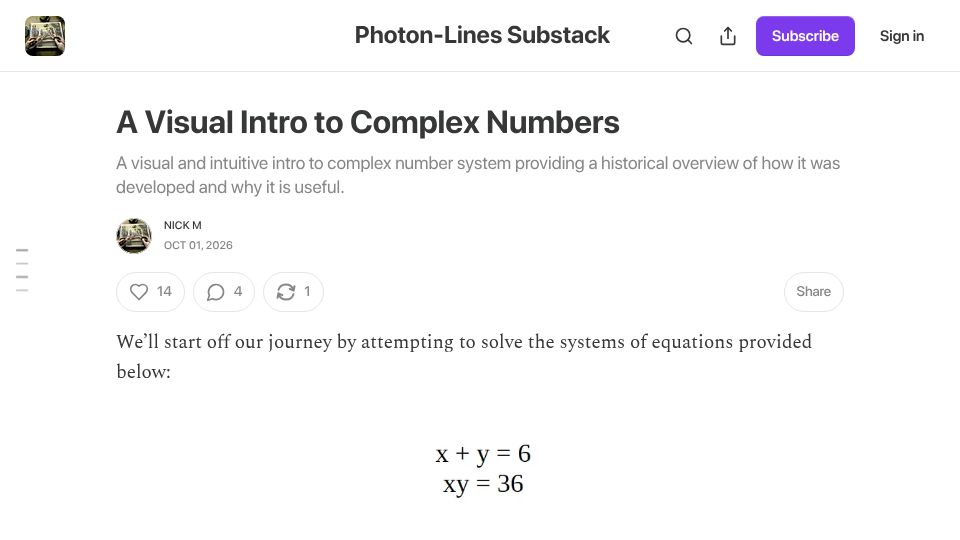
91 points by surprisetalk | 57 comments
A Substack article giving a visual, intuitive introduction to complex numbers, including a historical overview of how they were developed and why they are useful.
15 points by signa11 | 3 comments
A Patreon post by Vi Hart, in six parts, about the Navier-Stokes problem, the Lean theorem prover and Mathlib, OpenAI, and the politics of mathematics.
204 points by mochomocha | 129 comments
Ben Recht's argmin blog post critiquing OpenAI's math repository claim of a faster FFT algorithm, arguing it is more an exploit than a breakthrough.
16 points by speckx | 14 comments
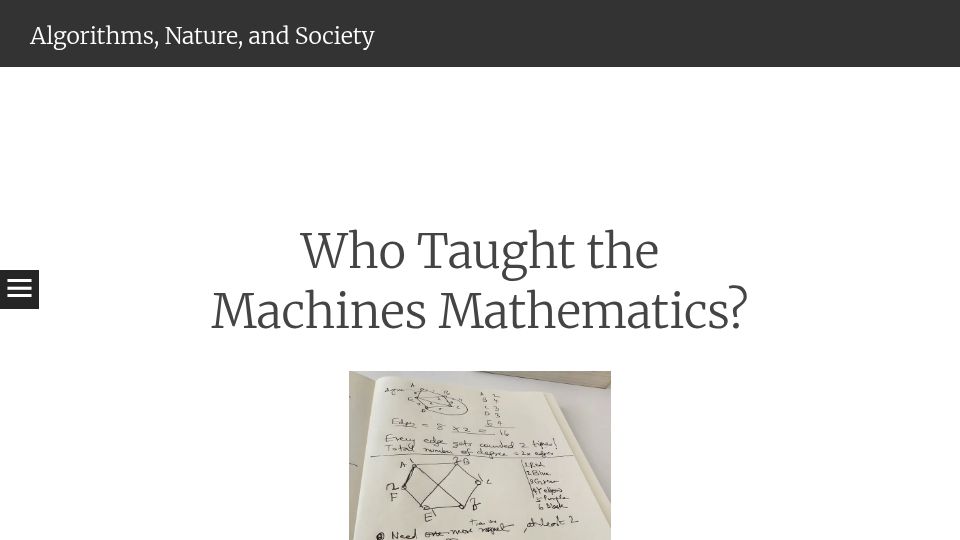
Blog post on Nisheeth Vishnoi's site 'Algorithms, Nature, and Society' asking who taught AI systems mathematics, illustrated with handwritten graph theory notes.
4 points by nhatcher | 2 comments
An arXiv paper presenting a strongly aperiodic monotile that tiles three-dimensional space only non-periodically.
92 points by smilelamp | 14 comments
A blog post on Terence Tao's blog titled "Illustration Beyond Proof"; the capture only shows a browser-check interstitial.
73 points by swesnow | 37 comments
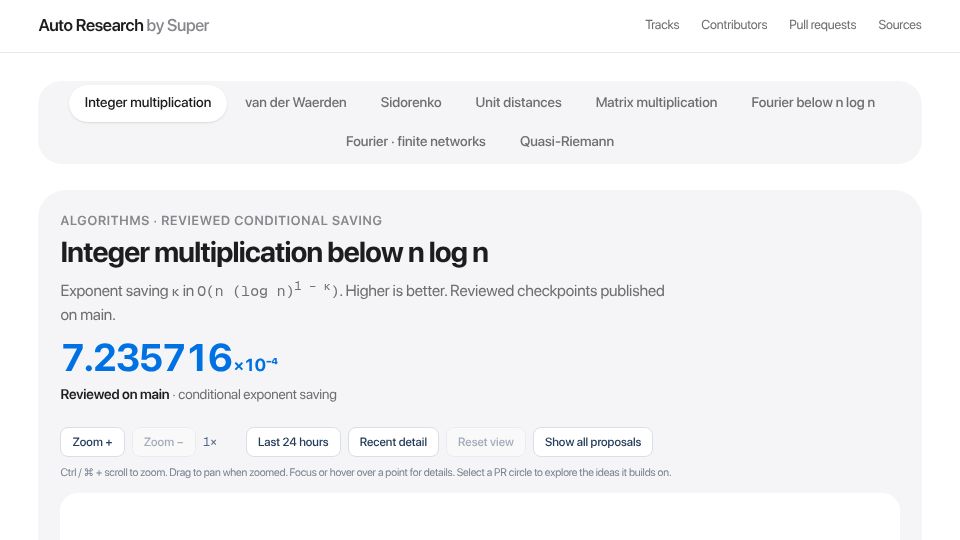
An Auto Research dashboard by Super tracking reviewed progress on open math problems, here the exponent saving for integer multiplication below n log n.
533 points by Anon84 | 530 comments
PDF slide deck titled "Math 2.0" by mathematician Terence Tao, dated October 2026, apparently from a Caltech talk.
249 points by subset | 49 comments
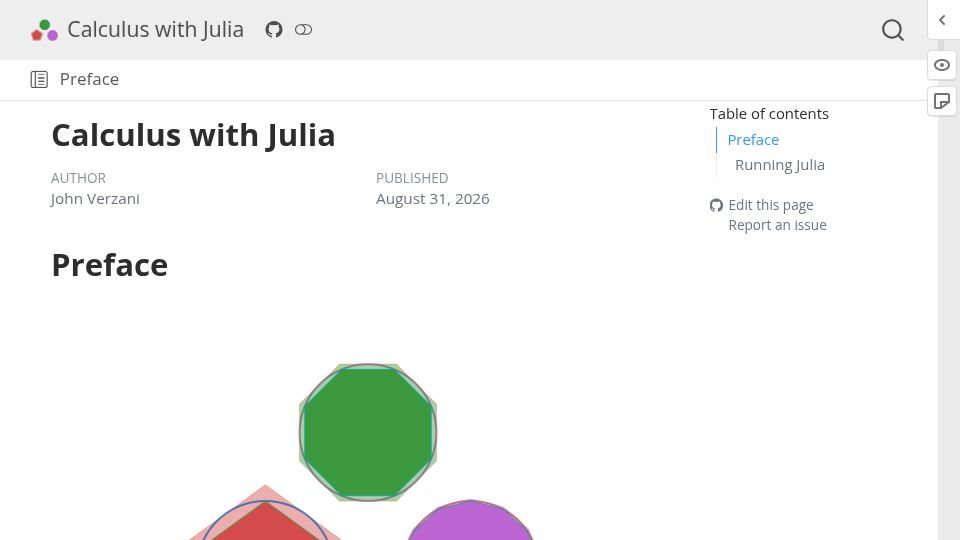
Online open textbook by John Verzani teaching calculus using the Julia programming language, shown at its preface page.
50 points by danielmorozoff | 5 comments
New Scientist article reporting that OpenAI's human-readable Navier-Stokes proof and its computer-formalized version do not match due to mistranslation into code.
178 points by matt_d | 50 comments
Terence Tao blog post on what mathematicians should know about the Lean theorem prover, covering reliability and AI; the capture shows only a browser-check interstitial.
8 points by marojejian | 6 comments
New York Times article on mathematicians' reactions to a new OpenAI release; the capture shows a bot-detection block page instead of the article.
79 points by jacobedawson | 73 comments
A blog post on Proofs and Prompts reacting to over 100 solutions, likely AI-generated math proofs; the page showed only a browser check screen.
129 points by sajid | 173 comments
A Terry Tao blog post titled "What should we tell our students?"; the capture shows only a browser-check interstitial instead of the content.
184 points by md224 | 275 comments
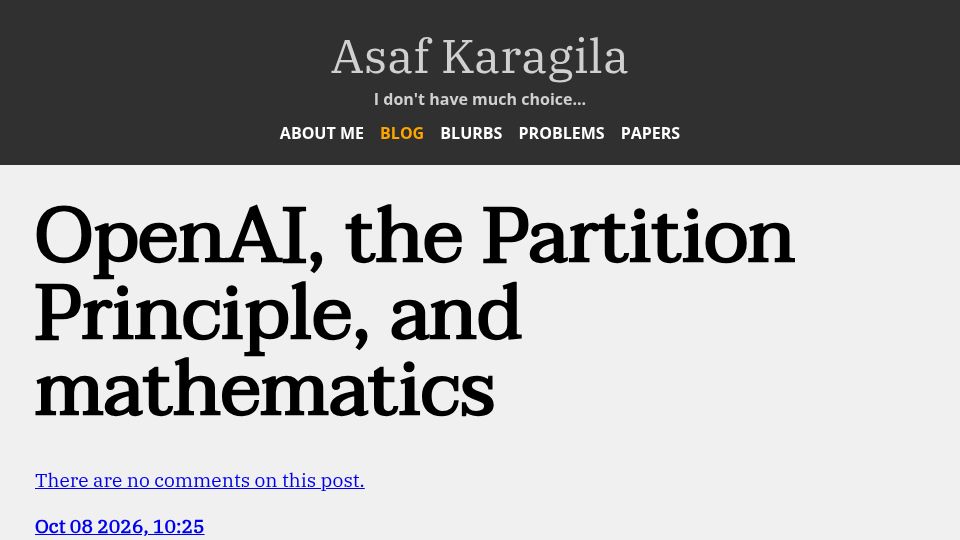
Blog post by set theorist Asaf Karagila discussing OpenAI in relation to the Partition Principle in set theory and mathematics.
35 points by kkoncevicius | 31 comments
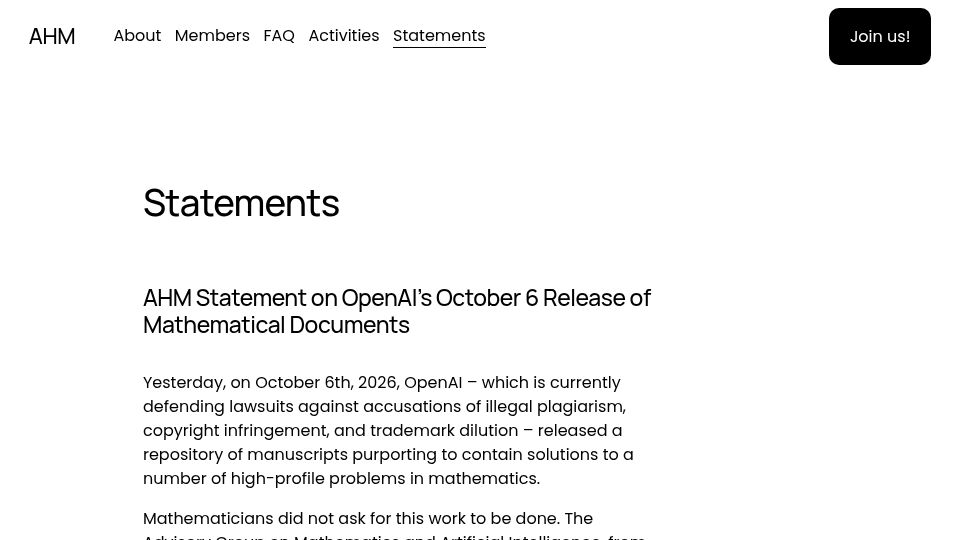
A statement from the AHM mathematicians' group responding to OpenAI's October 6, 2026 release of manuscripts claiming solutions to high-profile math problems.
335 points by theemathas | 321 comments
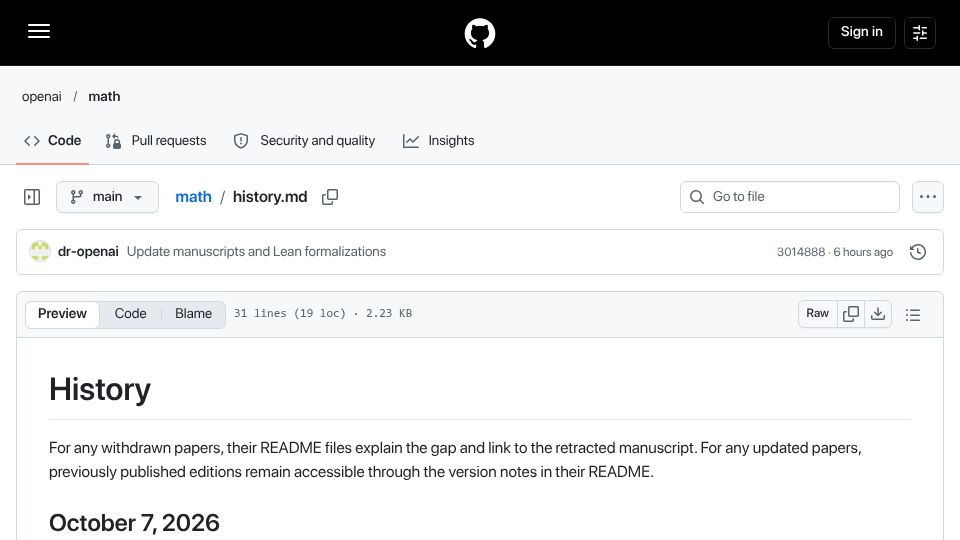
A history.md file in OpenAI's math GitHub repository logging withdrawn and updated math papers, with READMEs explaining gaps and linking retracted manuscripts.
355 points by sashank_1509 | 593 comments
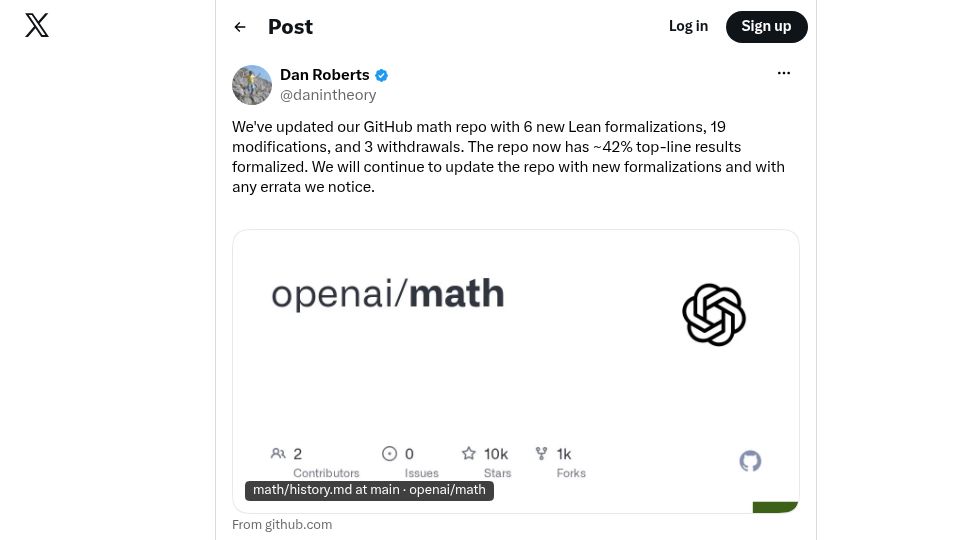
Tweet by Dan Roberts announcing updates to OpenAI's GitHub math repo: 6 new Lean formalizations, 19 modifications, and 3 withdrawn results.
579 points by ent101 | 603 comments
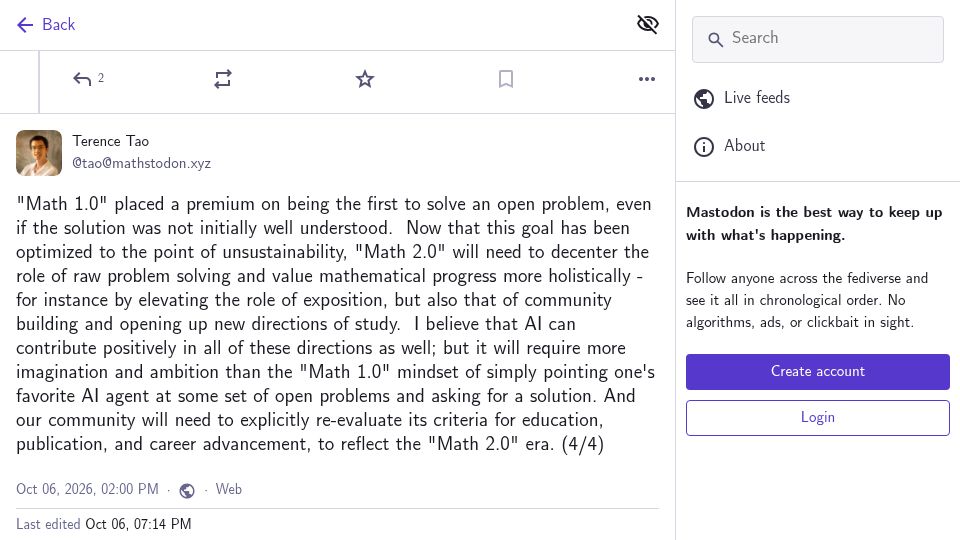
A Mastodon post by Terence Tao arguing that "Math 2.0" should value exposition, community building and new directions over raw problem solving, with AI playing a role.
109 points by bluepeter | 52 comments
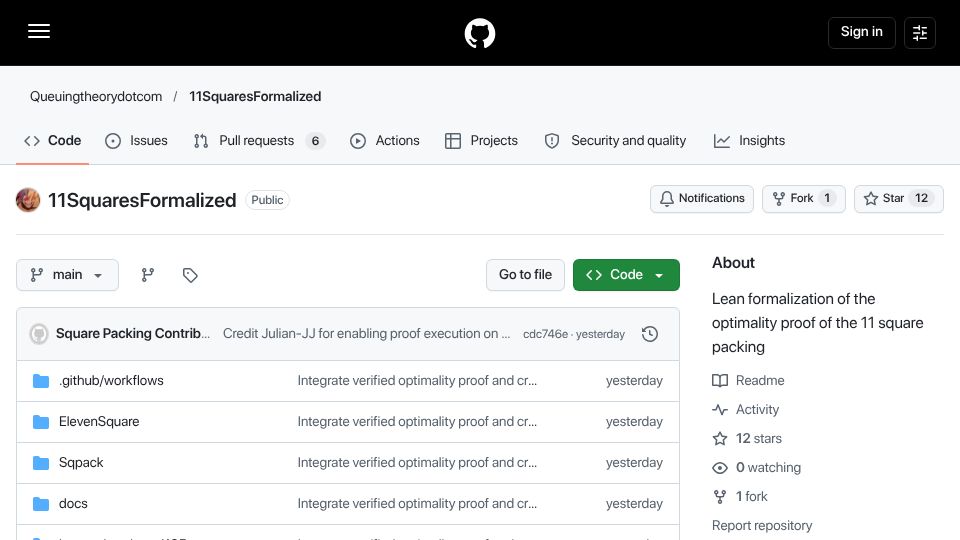
GitHub repository containing a Lean formalization of the optimality proof for packing 11 unit squares into the smallest square.
9 points by jumploops | 1 comments
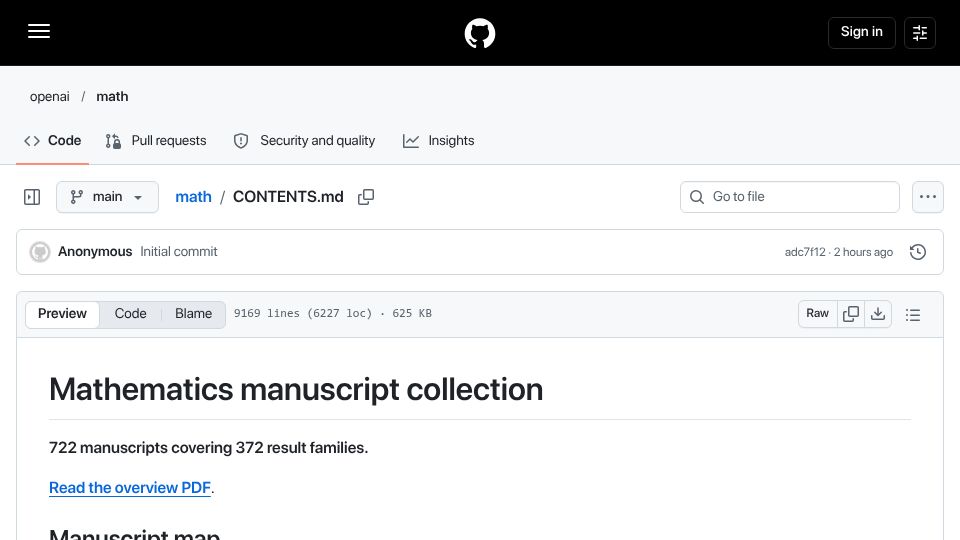
A CONTENTS.md file in OpenAI's GitHub math repository indexing a collection of 722 mathematics manuscripts covering 372 result families, with an overview PDF.
20 points by tootie | 6 comments
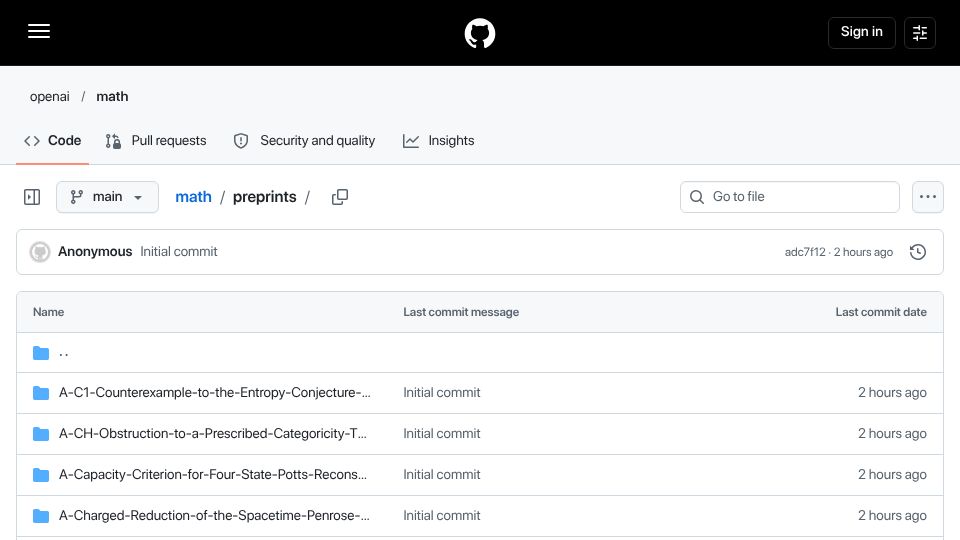
GitHub directory in OpenAI's math repository containing hundreds of preprints of mathematical proofs and counterexamples.
88 points by E-Reverance | 59 comments
GitHub directory in OpenAI's math repository containing a preprint paper and README on integer multiplication algorithms faster than n log n.
9 points by vikas-sharma | 0 comments
GitHub repository from OpenAI containing mathematical preprints, Lean proof artifacts, and reasoning traces produced by its models.
1314 points by OfficialTurkey | 1488 comments
OpenAI research publication page announcing its AI progress in mathematics, linking to a GitHub repository of math results and preprints.
246 points by djoldman | 55 comments
Wikipedia article on Cleo, the pseudonym of Vladimir Reshetnikov, known for posting precise answers to hard integrals on Math Stack Exchange without showing work.
86 points by pfdietz | 37 comments
Blog post by Thomas Bloom on erdosproblems.com describing how AI's rapid progress in solving Erdős problems is changing the site and its purpose.
57 points by signa11 | 8 comments
A blog post building intuition for Brownian motion by deriving its marginal distribution from a discrete-time random walk.
101 points by smilelamp | 53 comments
Guest post by Jeremy Avigad on Terence Tao's blog discussing the future of mathematics, framed by historical transformations of the subject.
35 points by nvtop | 38 comments
An essay by Christian Szegedy published as a Google Doc, reflecting on the future of mathematics, opening with his background in Hungarian math education.
47 points by 6bitquant | 34 comments
Stephen Wolfram essay on the role and future of human pure mathematics research as AI systems increasingly solve math problems.
62 points by bobajeff | 30 comments
YouTube video of Grant Sanderson's JPBM Communications Award lecture at the 2023 Joint Mathematics Meetings, titled "Math's pedagogical curse."
60 points by tejstead | 12 comments
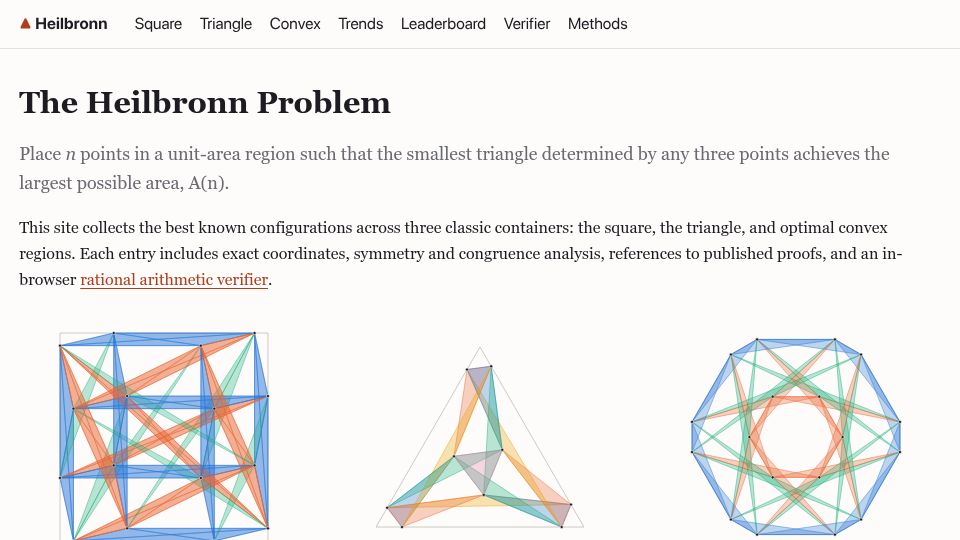
A website collecting the best known point configurations for the Heilbronn triangle problem in squares, triangles, and convex regions, with coordinates and an in-browser verifier.
292 points by suopspaces | 163 comments
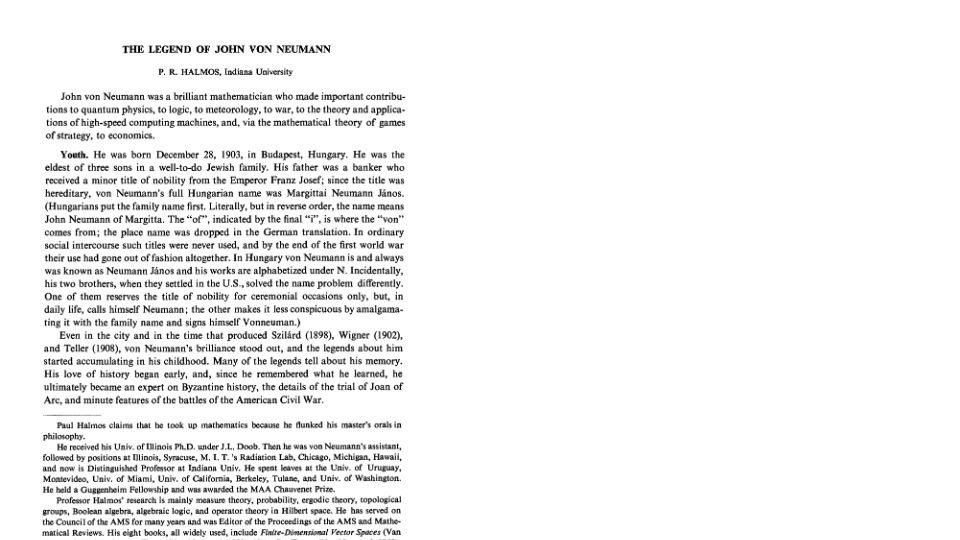
A 1973 essay by mathematician Paul Halmos recounting the life, achievements, and legends of John von Neumann, presented as a scanned PDF.
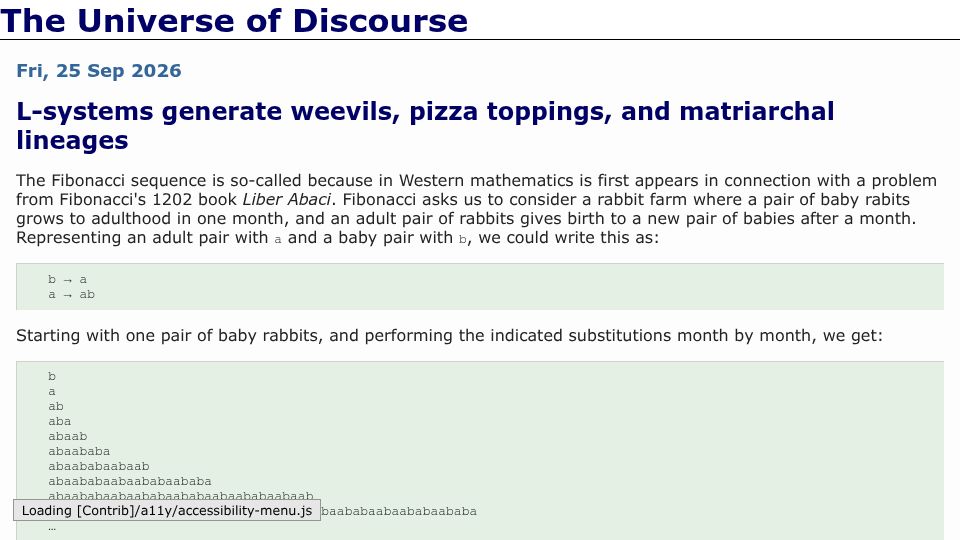
11 points by surprisetalk | 3 comments
Blog post from The Universe of Discourse explaining how L-system string rewriting, starting from Fibonacci's rabbit problem, models weevils, pizza toppings, and matriarchal lineages.
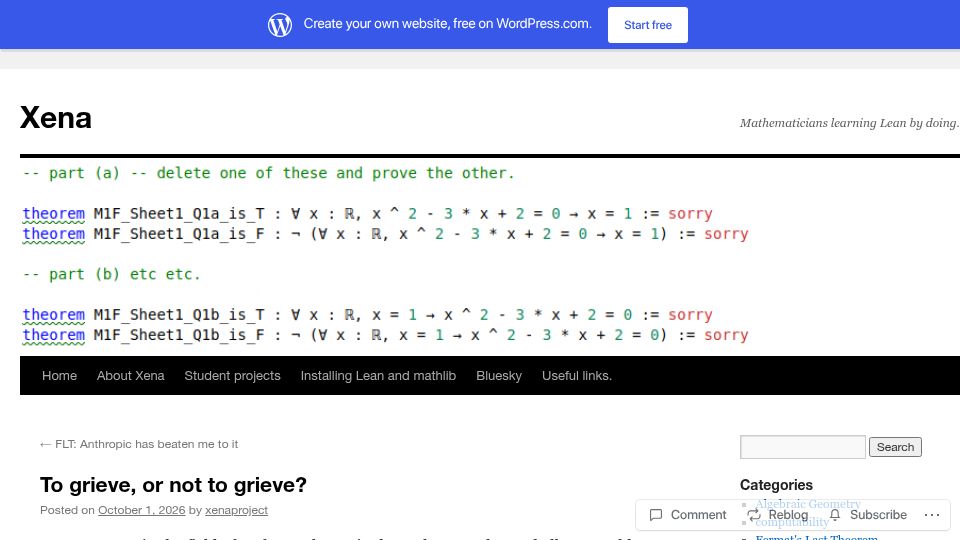
142 points by stabbles | 122 comments
A Xena Project blog post by a mathematician reflecting on whether to grieve as AI advances in formalizing mathematics in Lean, following a post about Anthropic and FLT.
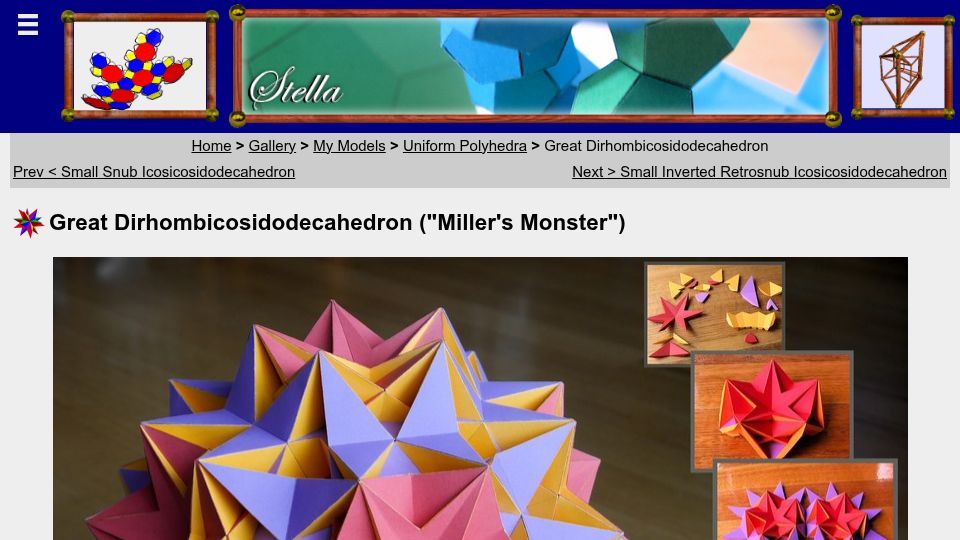
71 points by cobbzilla | 12 comments
A gallery page from the Stella polyhedron software site showing a paper model of the great dirhombicosidodecahedron, known as Miller's Monster.
104 points by aureianimus | 150 comments
A statement with recommendations on responsibly releasing AI-generated mathematics, urging frontier AI labs to stop testing advanced math problems on proprietary models.
358 points by srcreigh | 461 comments
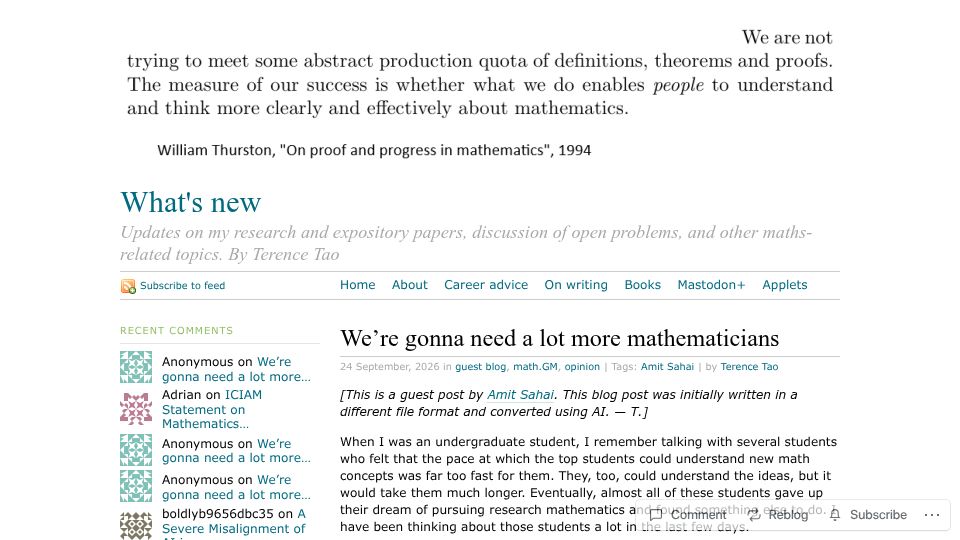
Guest post by Amit Sahai on Terence Tao's blog arguing that the world will need many more mathematicians, reflecting on students who left math due to pace.
112 points by pseudolus | 49 comments
Quanta Magazine article arguing that while biology may not rely on quantum effects, the mathematics describing biological systems resembles quantum math.
61 points by cebert | 7 comments
A blog post explaining the Fourier transform and using rotating vectors (epicycles) to draw a llama outline, covering complex numbers and linear algebra.
78 points by gmays | 34 comments
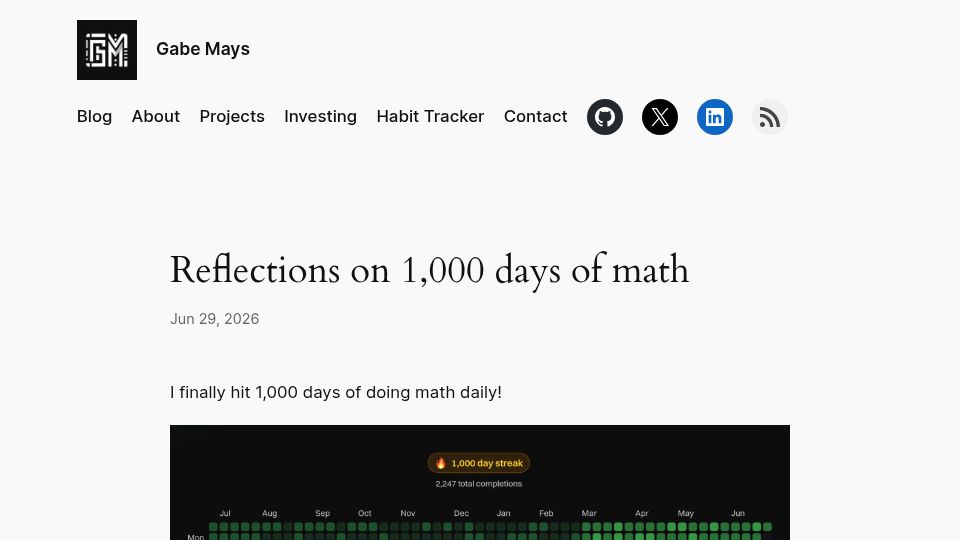
Gabe Mays' blog post reflecting on reaching a 1,000-day streak of studying math daily, with a habit-tracker heatmap.
92 points by tomjakubowski | 46 comments
Scientific American article on whether OpenAI's claimed Navier-Stokes proof qualifies for the $1-million Millennium Prize only through a controversial loophole.
150 points by digital55 | 76 comments
Guest post on Terence Tao's blog announcing the Advisory Group on Mathematics and Artificial Intelligence, with members including Tao, Gowers, Hairer, Witten and others.
383 points by num42 | 275 comments
Guest post by Grant Sanderson on Terence Tao's blog arguing that mathematics is about understanding, not just proofs, and that non-proof contributions deserve more recognition.
317 points by rvz | 253 comments
Clay Mathematics Institute news page titled "Navier-Stokes Announcement," dated 11 September 2026, concerning the Navier-Stokes Millennium Prize problem.
1171 points by meredydd | 1120 comments
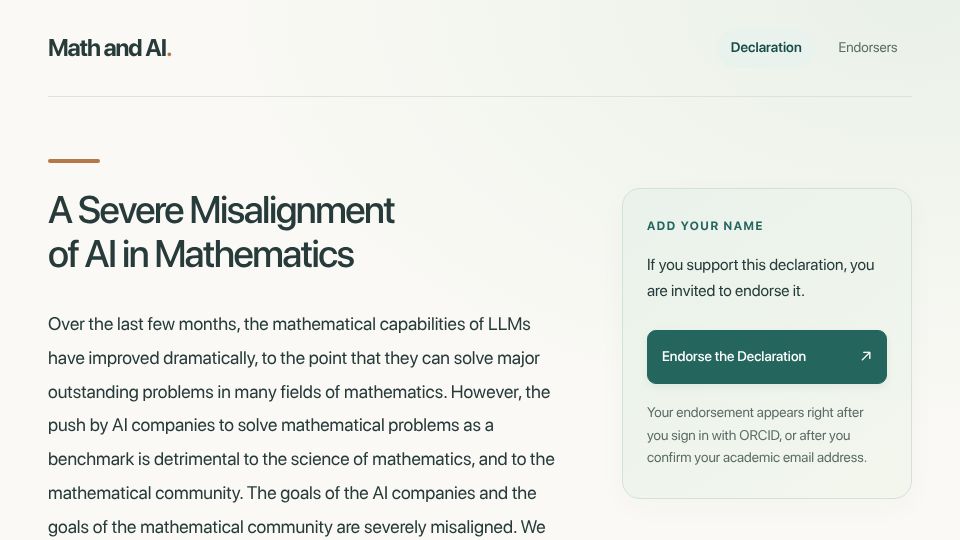
A declaration by mathematicians arguing that AI companies' use of math problems as benchmarks harms mathematics and the mathematical community, inviting endorsements.
845 points by pred_ | 787 comments
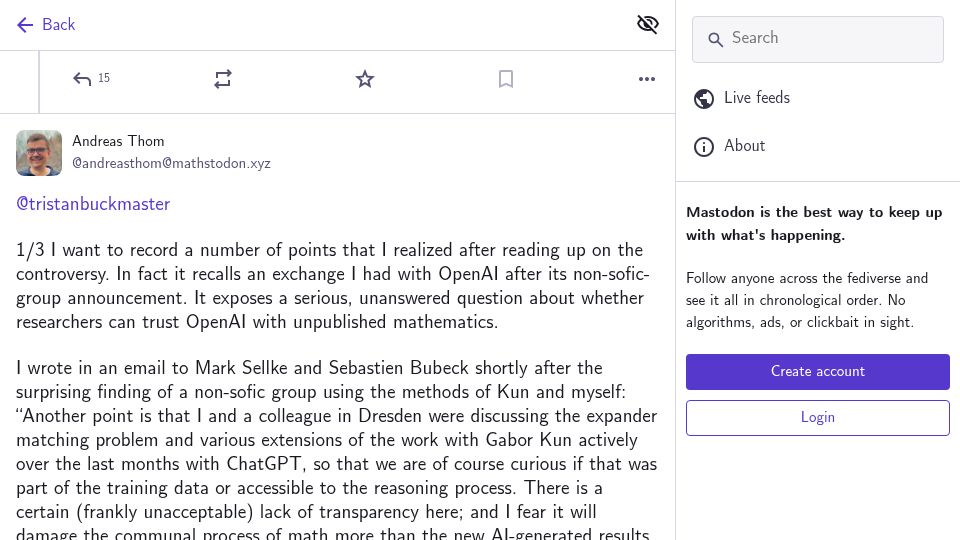
Mastodon thread by mathematician Andreas Thom questioning whether researchers can trust OpenAI with unpublished mathematics shared via ChatGPT, citing the non-sofic group result.
418 points by _alternator_ | 359 comments
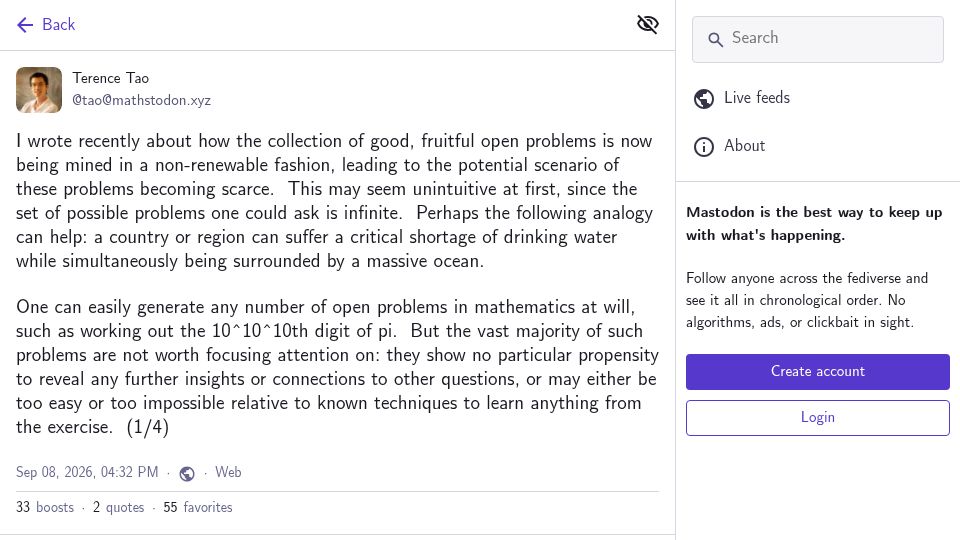
A Mastodon thread by Terence Tao arguing that good, fruitful open math problems are a scarce resource being mined non-renewably, using a drinking-water analogy.
1295 points by tedsanders | 1045 comments
OpenAI research publication page on the Navier–Stokes Millennium Prize Problem, linking to a paper and a Lean formalized proof.
1947 points by procedurecall | 798 comments
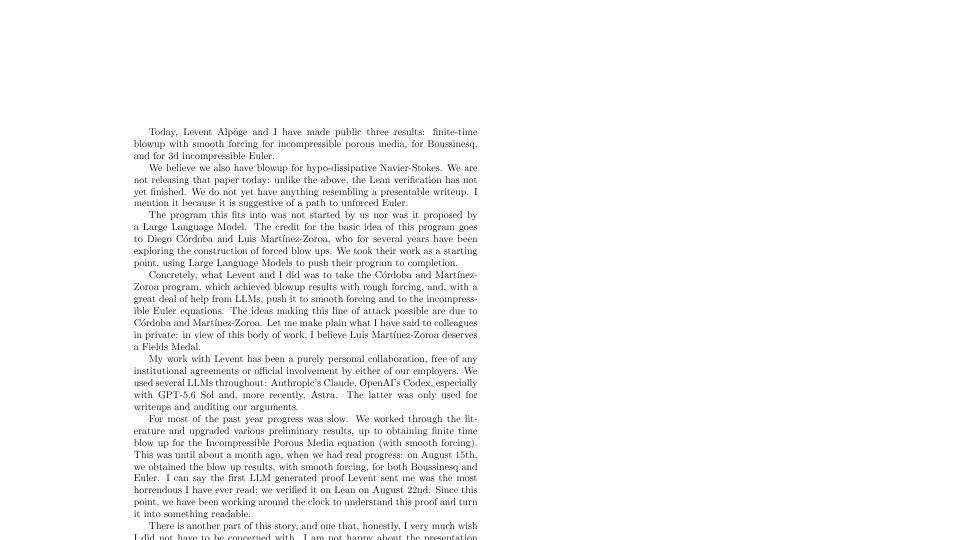
A PDF statement by mathematician Tristan Buckmaster announcing LLM-assisted, Lean-verified blowup results for Boussinesq, 3D Euler, and porous media equations with smooth forcing.
743 points by jlebar | 479 comments
Anthropic research post on formalizing the proof of Fermat's Last Theorem, apparently using Claude, with a linked Xena Project blog response.
582 points by matthewsinclair | 77 comments
A Big Think YouTube video in which mathematician Terence Tao explains six essential concepts of mathematics.
524 points by rzk | 452 comments
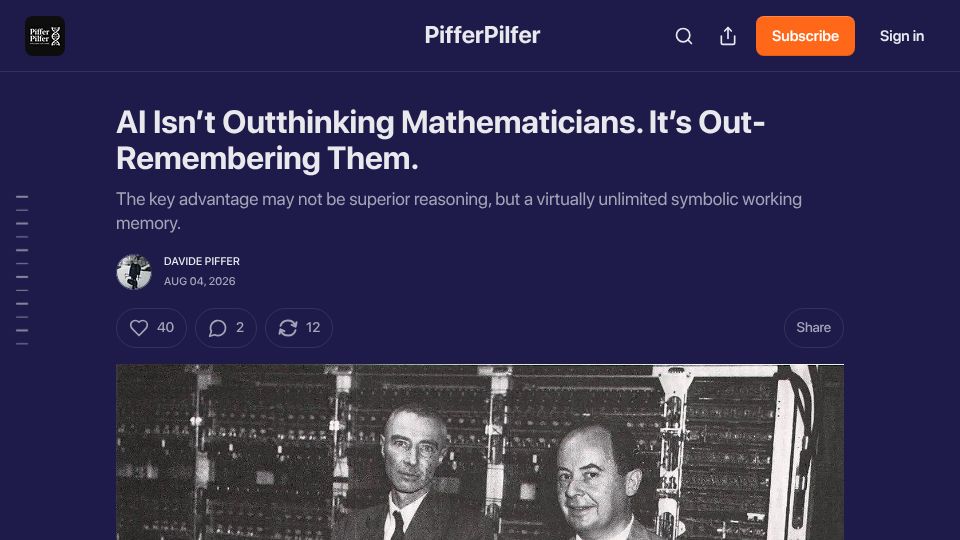
A Substack essay by Davide Piffer arguing that AI's edge over mathematicians comes from a vast symbolic working memory rather than superior reasoning.
609 points by milkshakes | 892 comments
OpenAI publication page announcing ten advances in mathematics and theoretical computer science, with links to the paper and reasoning walkthroughs.
373 points by milkshakes | 252 comments
OpenAI page about ten advances in mathematics and theoretical computer science; it loaded only a Cloudflare verification challenge.
540 points by agnishom | 89 comments
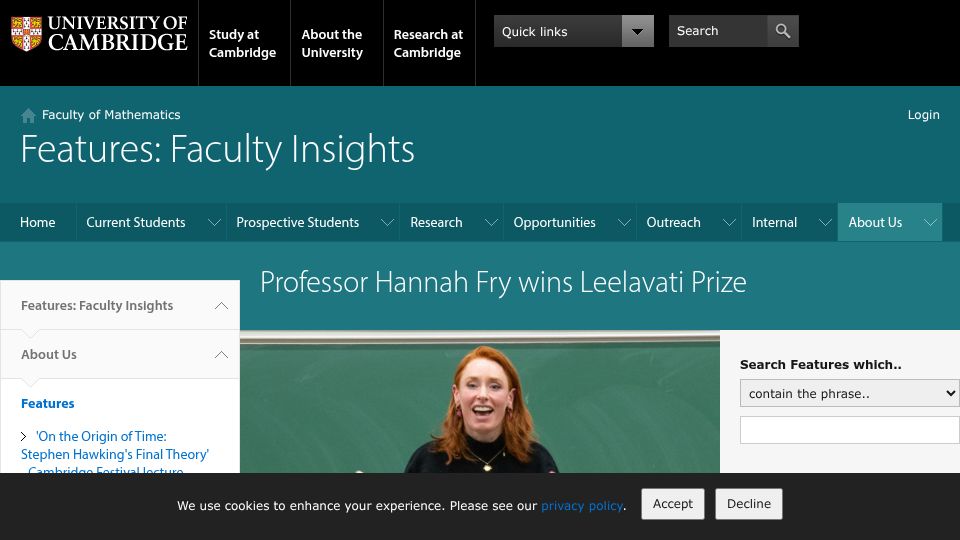
University of Cambridge Faculty of Mathematics feature announcing that Professor Hannah Fry has won the Leelavati Prize for mathematics outreach.
1028 points by gmays | 587 comments
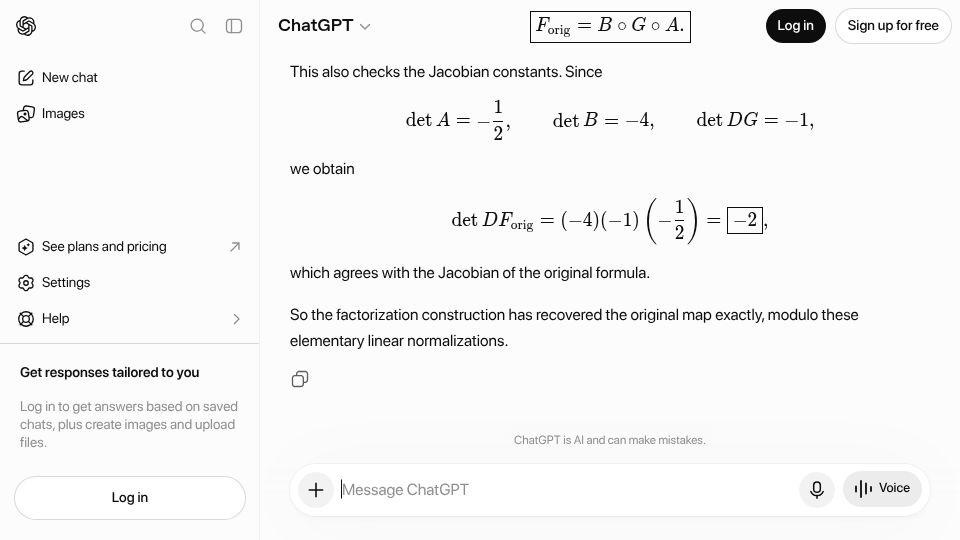
A shared ChatGPT conversation, attributed to Terence Tao, working through the factorization and Jacobian check of a claimed Jacobian Conjecture counterexample.
456 points by artninja1988 | 225 comments
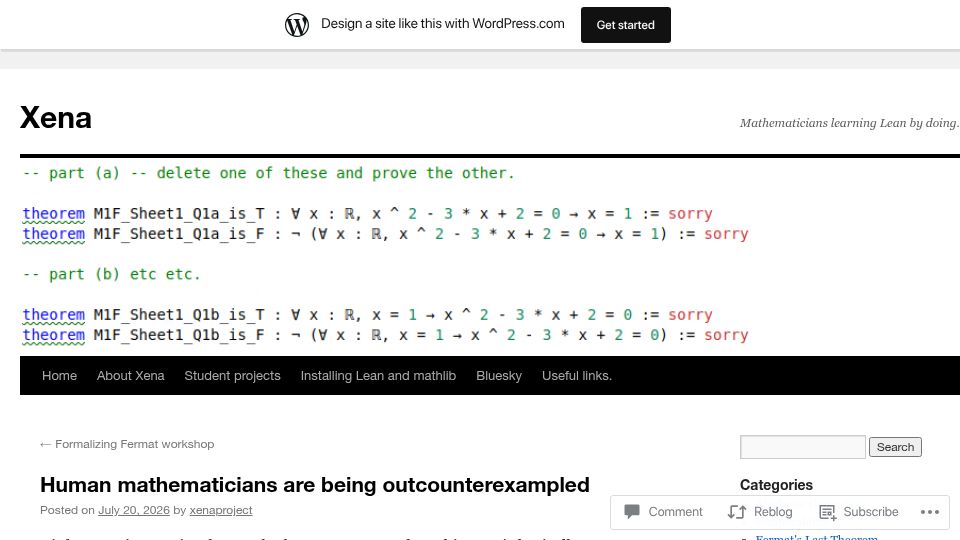
A Xena Project blog post about mathematicians being outpaced at finding counterexamples, from the blog on mathematicians learning the Lean theorem prover.
756 points by loubbrad | 471 comments
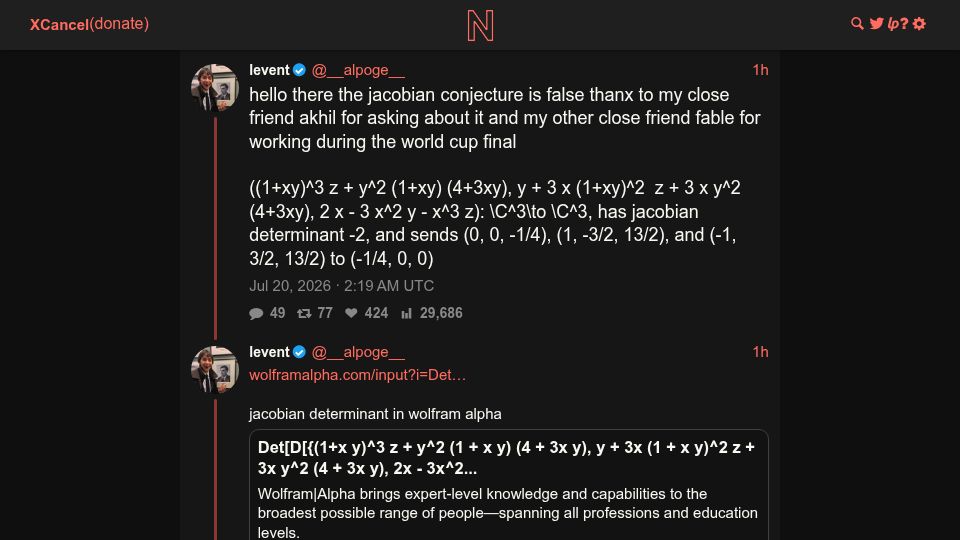
An xcancel mirror of a tweet thread by Levent Alpoge claiming an explicit polynomial map C^3→C^3 with constant Jacobian -2 that is not injective, disproving the Jacobian Conjecture.
346 points by aleda145 | 134 comments
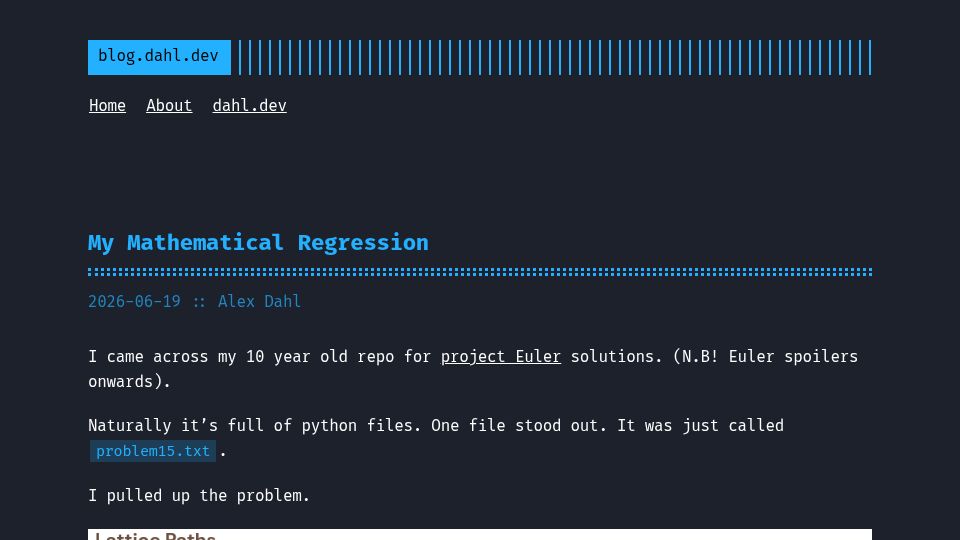
Blog post in which the author revisits a decade-old Project Euler solutions repo and reflects on a plain-text answer to problem 15, Lattice Paths.
1339 points by tedsanders | 968 comments
OpenAI announcement that one of its models disproved a central conjecture in discrete geometry, with links to the proof and companion remarks.
683 points by _alternator_ | 510 comments
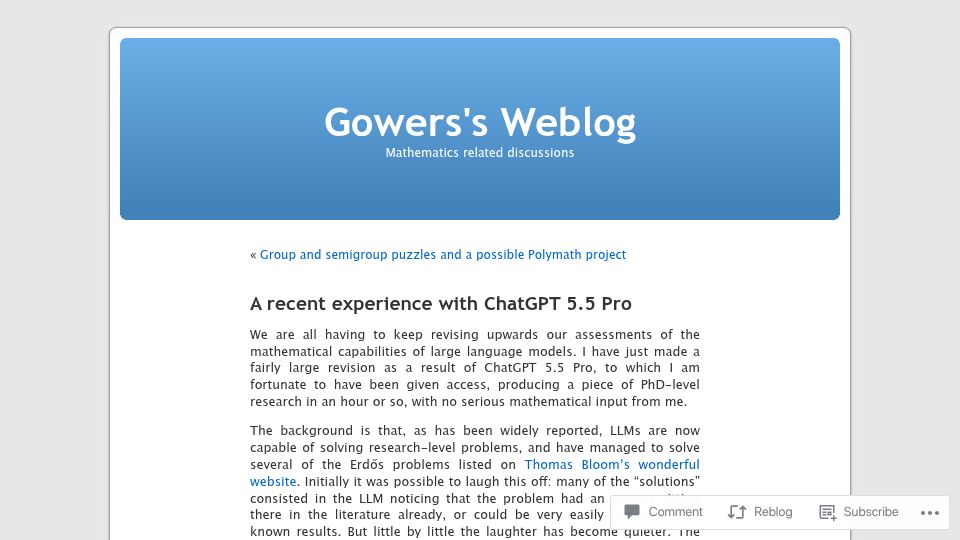
Timothy Gowers's blog post describing how ChatGPT 5.5 Pro produced PhD-level mathematical research in about an hour with little input from him.
733 points by pr337h4m | 508 comments
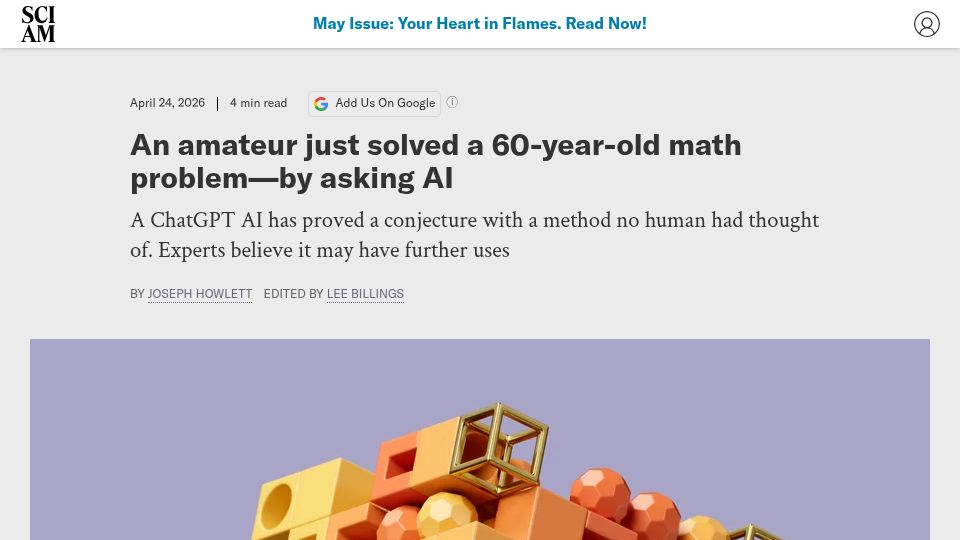
Scientific American article about an amateur who used ChatGPT to prove a 60-year-old Erdős conjecture with a novel method.
777 points by pizza | 246 comments
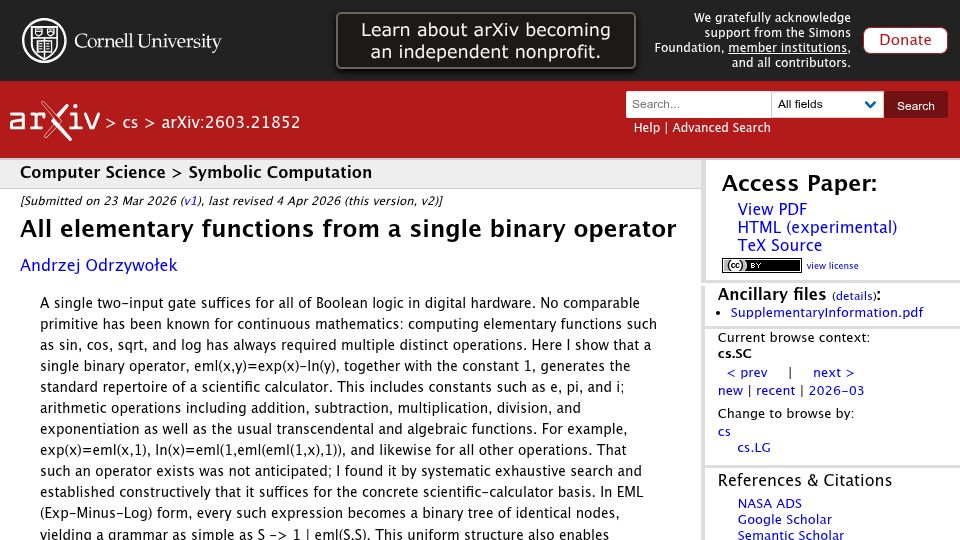
arXiv paper showing a single binary operator eml(x,y)=exp(x)-ln(y) with constant 1 generates all elementary functions of a scientific calculator.
742 points by fs123 | 311 comments
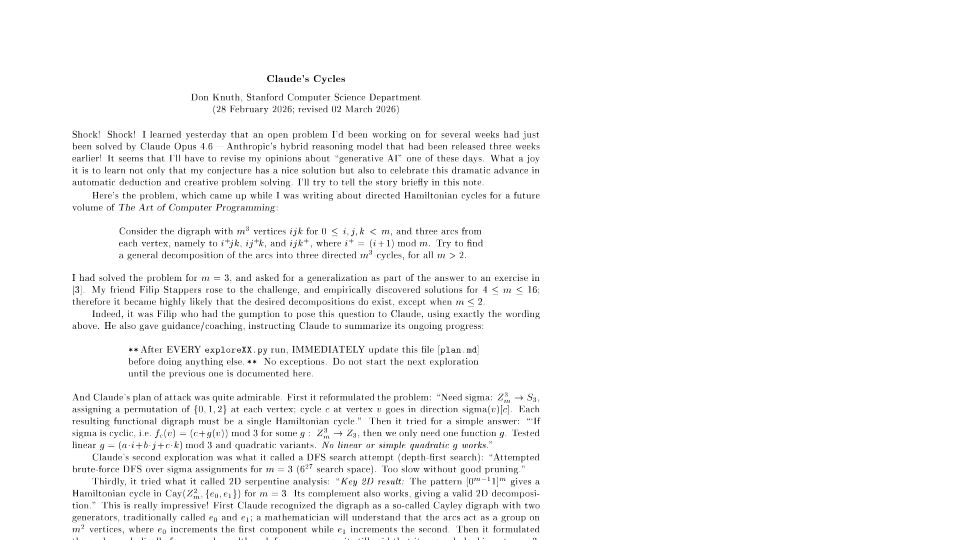
Don Knuth's note describing how Claude Opus 4.6 solved his open problem on decomposing a 3D torus digraph's arcs into three directed Hamiltonian cycles.
456 points by gurjeet | 278 comments
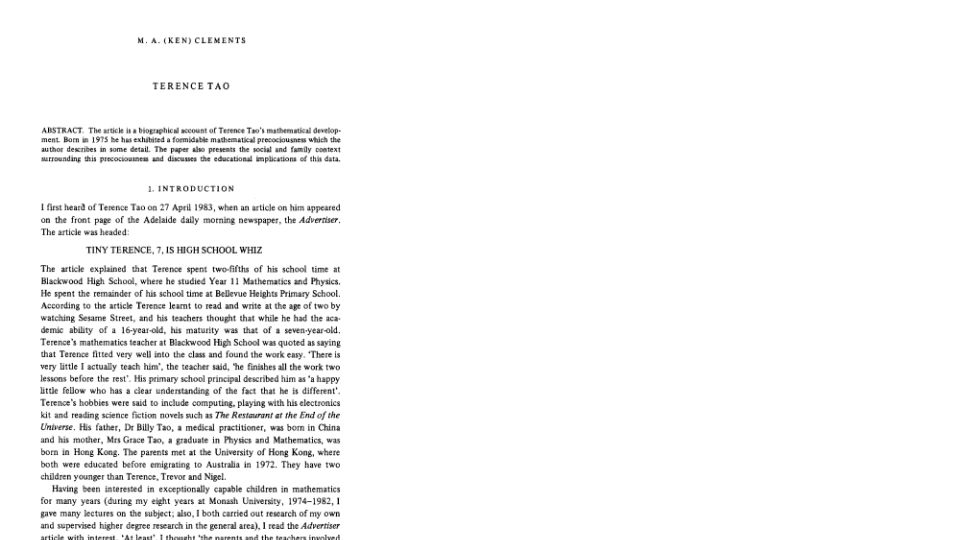
A 1984 academic paper by M. A. (Ken) Clements giving a biographical account of Terence Tao's mathematical precociousness as a young child and its educational implications.
332 points by o4c | 70 comments
A free PDF textbook by Andrew D. Hwang, 'Calculus for Mathematicians, Computer Scientists, and Physicists: An Introduction to Abstract Mathematics'.
518 points by swatson741 | 126 comments
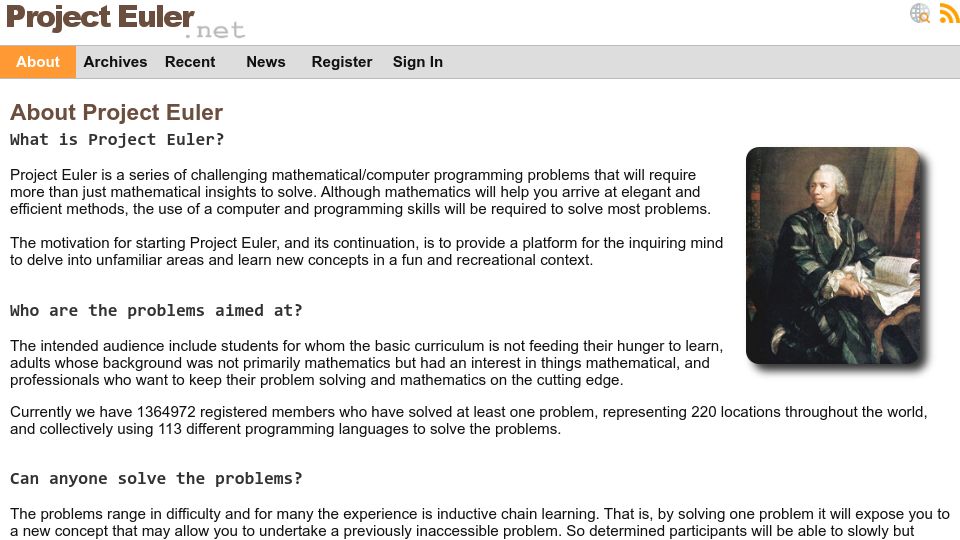
The About page of Project Euler, a site offering a series of challenging mathematical and computer programming problems for recreational learning.