
Two Million Hornets(dark-mountain.net)
30 points by promulgate | 4 comments
An essay by Tom Smith from Dark Mountain Issue 30 about trapping invasive Asian hornets, wildfires, and changing mountain communities in northern Spain.
67 stories tagged essay, newest first.
30 points by promulgate | 4 comments
An essay by Tom Smith from Dark Mountain Issue 30 about trapping invasive Asian hornets, wildfires, and changing mountain communities in northern Spain.
134 points by rafaelc | 87 comments
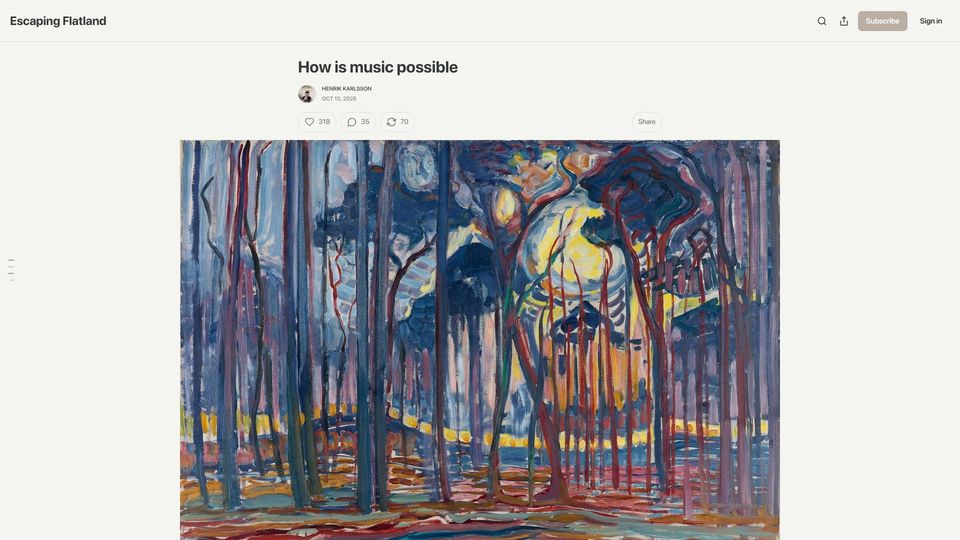
An essay by Henrik Karlsson on Escaping Flatland exploring why music moves us, weighing music psychology, Schopenhauer's metaphysics, and emergence as explanations.
139 points by ctoth | 79 comments
Robert A. Heinlein's 1952 "This I Believe" essay on the decency of neighbors and humanity, reposted on Awakin.org with reader reflections.
21 points by royalroad | 5 comments
An essay on the science blog The Last Word On Nothing titled "My Neighbor, Me, and a Grand Principle."
58 points by tirumaraiselvan | 19 comments
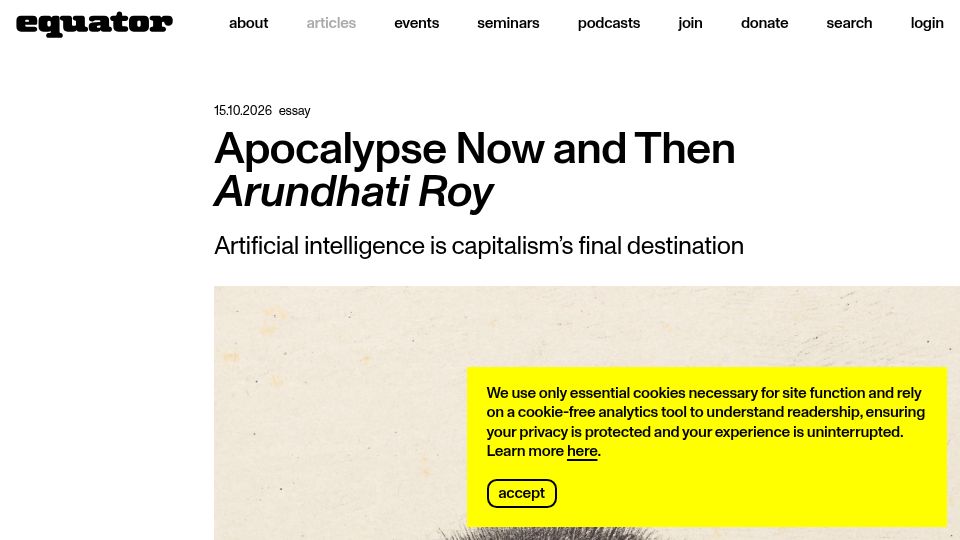
An essay by Arundhati Roy in Equator magazine, "Apocalypse Now and Then," arguing that artificial intelligence is capitalism's final destination.
62 points by andsoitis | 49 comments
A 2012 short essay by Derek Sivers arguing that dismissing groups of people as stupid shows a lack of understanding, from his book Hell Yeah or No.
10 points by fathermarz | 4 comments
A Substack essay questioning whether perceived cognitive decline might instead reflect increasing sanity or changed priorities.
18 points by jruohonen | 7 comments
A reprint of Theodore Roszak's 1962 essay "The Disease called Politics," a critique of politics, hosted on the Panarchy document archive site.
260 points by zetalyrae | 162 comments
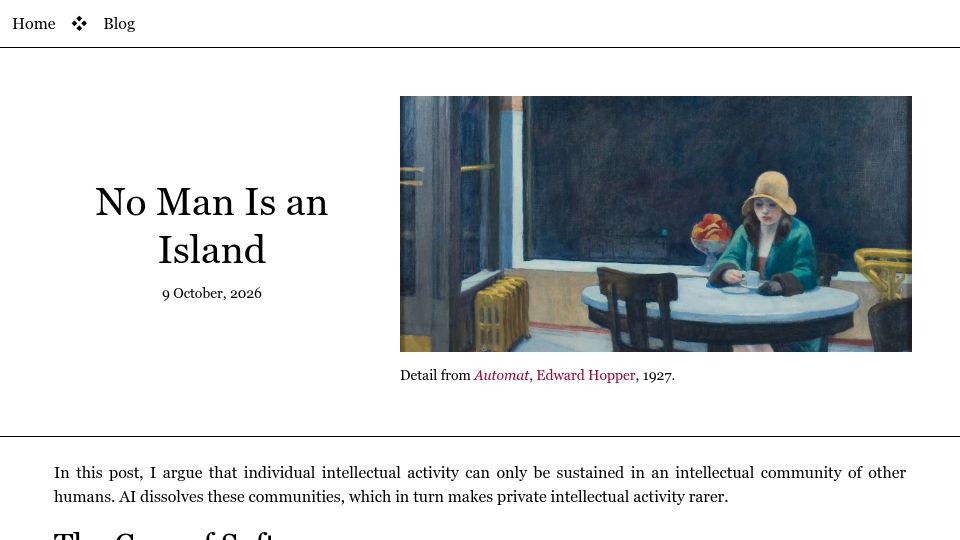
Blog essay arguing that individual intellectual activity depends on human intellectual communities, which AI is dissolving.

129 points by eustoria | 87 comments
An OnlySky essay arguing that everyone depends on others and that the future of independence lies in recognizing interdependence.
35 points by nvtop | 38 comments
An essay by Christian Szegedy published as a Google Doc, reflecting on the future of mathematics, opening with his background in Hungarian math education.
4 points by Vigier | 0 comments
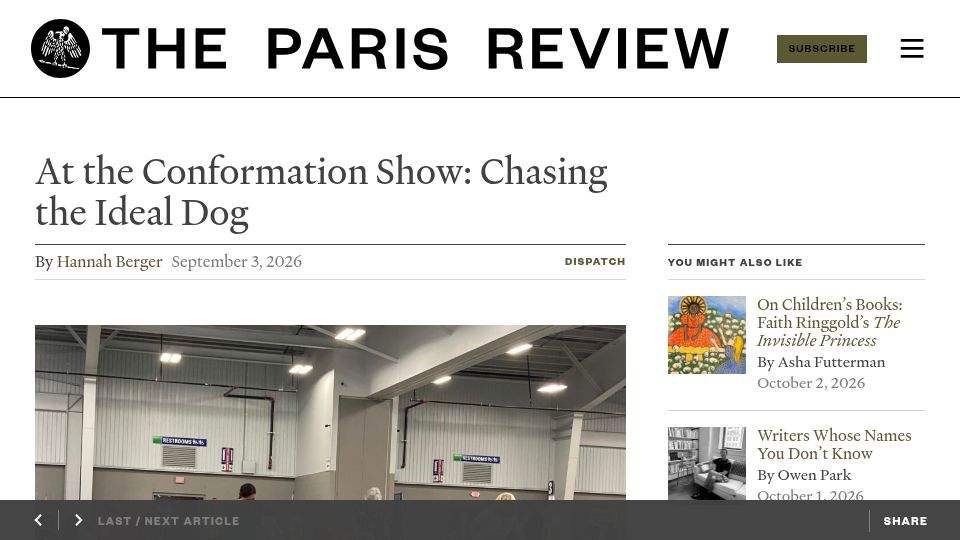
A Paris Review Daily dispatch by Hannah Berger about attending a dog conformation show and the pursuit of the ideal dog.
12 points by raybb | 2 comments
An essay by Josh Albrecht on Imbue's Substack arguing for a new personal computing revolution that restores user control, free of subscriptions, ads and dark patterns.
4 points by dimonomid | 0 comments
A personal blog essay using Cato the Younger's speech on the Catiline conspiracy, as recorded by Sallust, to reflect on how the software field names things.
10 points by Avid_F | 3 comments
A personal blog essay on Fayaz Notes arguing that AGI has arrived and exploring what the post-AGI era means.
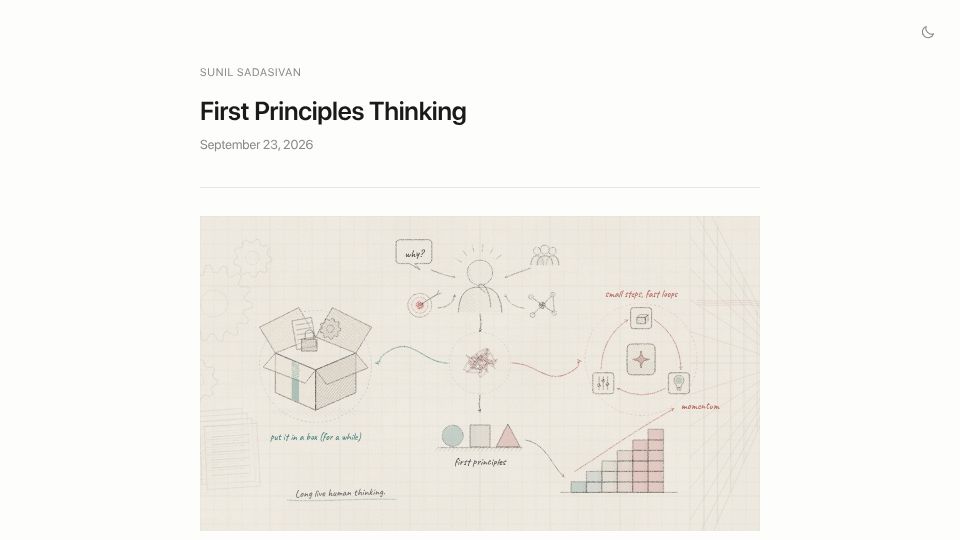
270 points by sunils34 | 117 comments
A personal blog essay by Sunil Sadasivan on first principles thinking, illustrated with a sketch diagram about questioning assumptions and iterating.

130 points by latexr | 55 comments
A blog post titled "The Test" on tante's Smashing Frames blog, headed by a photo of a gloved hand holding a lab sample tube.
14 points by rDr4g0n | 2 comments
An essay arguing that people should fear the companies building AI rather than AI itself, appealing to readers' intuition that something is wrong.
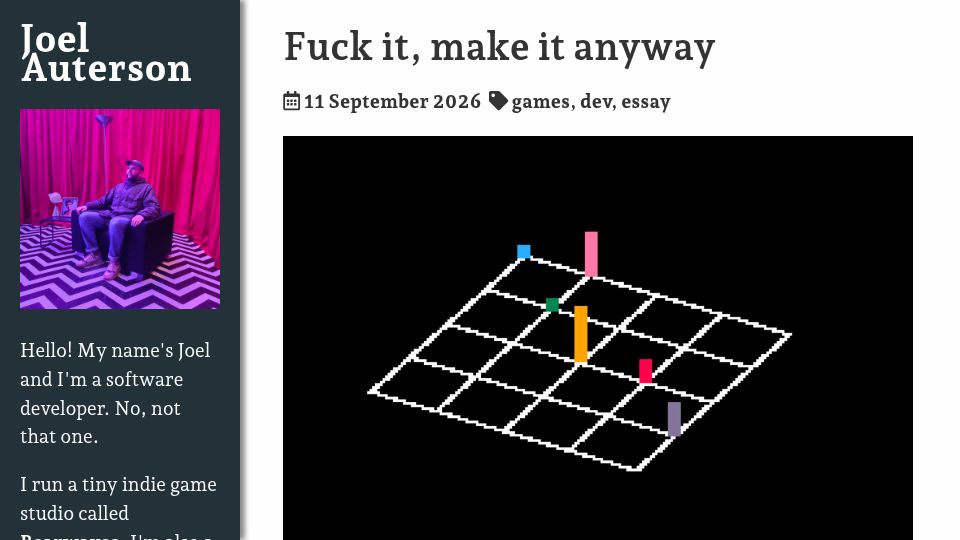
504 points by JayOtter | 495 comments
A personal blog essay by indie game developer Joel Auterson encouraging people to make their creative projects anyway despite doubts.
362 points by rglover | 137 comments
A blog essay arguing that the conditions of software work—speed, money, complexity, abstraction, and freedom to change—make normal people lose their sense of proportion.
347 points by ibobev | 228 comments
Stephen Diehl blog essay arguing the modern internet has become predatory compared with the amateur, non-commercial web of the 1990s.
818 points by Ariarule | 328 comments
Adam Mastroianni's Experimental History Substack essay "I like 'em thick," subtitled an apology to his English teachers, apparently about writing style.
640 points by tsak | 500 comments
A personal blog essay arguing that taste is the remaining differentiator in software development, with sections on friction, economics, and the flood of new software.
351 points by vinhnx | 134 comments
John Salvatier's 2017 blog essay arguing, via examples like building stairs, that reality's hidden detail explains why people get intellectually stuck.
634 points by kingstoned | 1643 comments
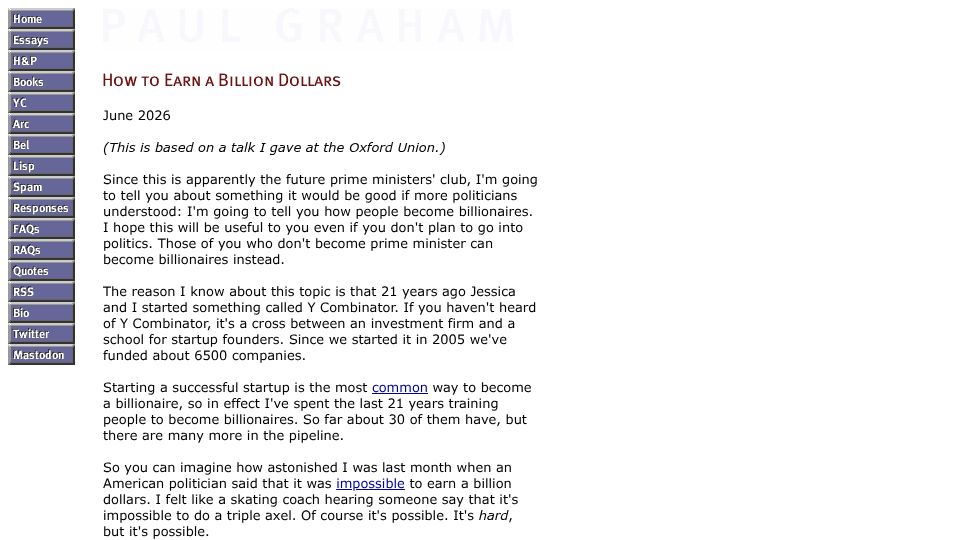
Paul Graham essay, based on an Oxford Union talk, explaining how people become billionaires, chiefly by starting successful startups.
331 points by antirez | 172 comments
Personal blog essay by Caleb Gross arguing against valuing humans only for output quality that AI may eventually match, and for stating human value directly.
520 points by garycomtois | 201 comments
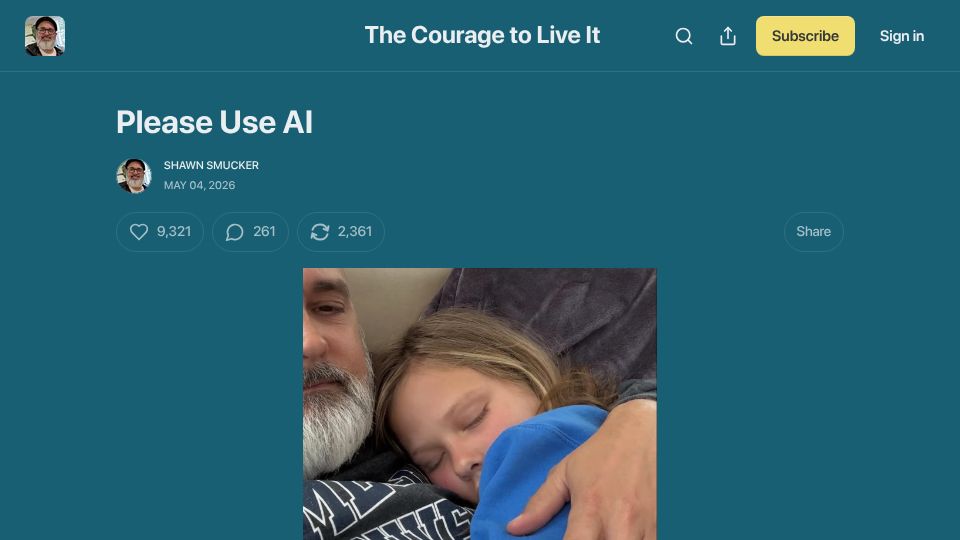
A Substack essay by writer Shawn Smucker titled "Please Use AI," published on his newsletter The Courage to Live It.
362 points by ColinWright | 320 comments
A blog post by Mat Duggan arguing that cyberlibertarian ideology in the tech world is hypocritical, opening with reflections on life before the Internet.
336 points by calcifer | 311 comments
A satirical blog post listing ironic tips on how to be anti-social, such as assuming malice, avoiding challenges to assumptions, and digging in against dissent.
675 points by aphyr | 695 comments
Final installment of Aphyr's essay series on LLMs and society, discussing where to go from here given the harms and implications of machine learning.
564 points by pabs3 | 549 comments
Aphyr's essay "The Future of Everything is Lies, I Guess," the opening of a multi-part series reflecting critically on LLMs and machine learning's societal effects.
318 points by surprisetalk | 308 comments
An essay by Joan Westenberg arguing that Marc Andreessen's dismissive views on introspection are mistaken.
788 points by vaylian | 250 comments
Blog essay by Armin Ronacher arguing that some valuable things, like mature trees or established software and communities, can only be achieved through time.

899 points by MBCook | 331 comments
Personal blog essay by Sam Henri Gold reflecting on growing up with Apple computers, opening with a childhood photo of himself at a desk with Macs.

691 points by Samin100 | 237 comments
Personal essay by Sharif Shameem arguing that willingness to look foolish is an underrated advantage, or moat, in creative work.
460 points by bigwheels | 352 comments
Paul Graham essay "The Brand Age" (March 2026), opening with the 1970s Swiss watch industry quartz crisis to discuss the role of brands.
336 points by machielrey | 165 comments
Personal blog essay by Machiel Reyneke exploring why people in the longevity space are obsessed with living forever, framed through the metaphor of vampires.
516 points by zdw | 252 comments
Kevin Kelly essay on The Technium reflecting on the dependable kindness of strangers he experienced while hitchhiking and traveling through Asia.

337 points by Amorymeltzer | 254 comments
Dan Wang's 2025 annual letter, a year-in-review essay comparing Silicon Valley and the Chinese Communist Party, among other reflections.

329 points by jesseduffield | 164 comments
A 2014 blog post by Graydon Hoare arguing that text is the most powerful and durable communication medium; the capture shows a Dreamwidth captcha page instead.
785 points by mitchbob | 252 comments
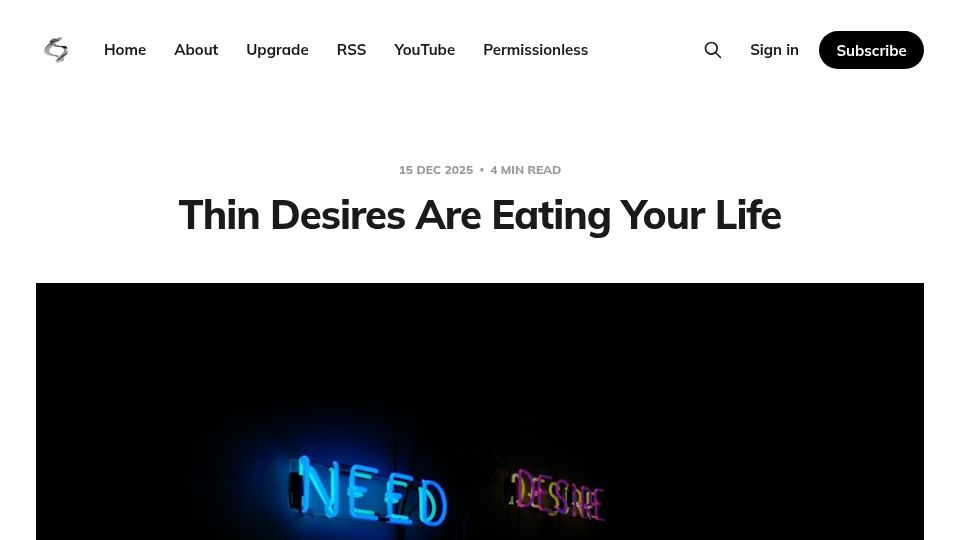
Joan Westenberg essay arguing that shallow, easily satisfied 'thin desires' driven by modern technology are crowding out deeper, more meaningful wants.
443 points by delaugust | 338 comments
Christopher Butler's blog essay "What AI is Really For," arguing that AI serves as a front for consolidating resources and power.
430 points by downboots | 196 comments
A short essay listing activities like preparing, scheduling, and making to-do lists that feel productive but are not actually doing the thing.
425 points by ipnon | 150 comments
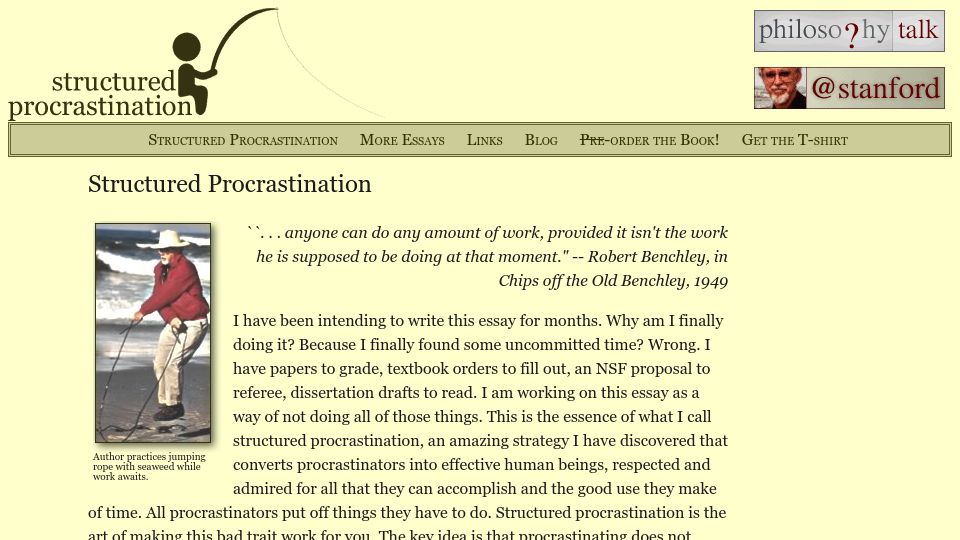
John Perry's classic 1995 essay describing structured procrastination, a strategy for getting work done by putting off other, more important tasks.
826 points by coderintherye | 316 comments
A PDF essay by Edward Packard, creator of Choose Your Own Adventure books, sharing nine lessons from his ninety years of life.
707 points by jger15 | 194 comments
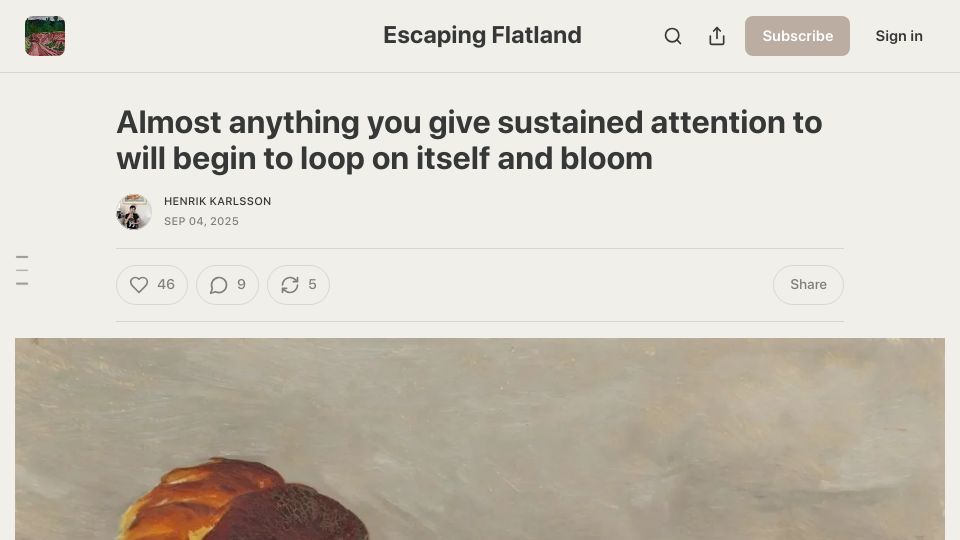
An essay by Henrik Karlsson on Escaping Flatland arguing that sustained attention to almost anything makes it loop on itself and bloom into richness.
343 points by tosh | 132 comments
Mitchell Hashimoto's essay arguing that meeting checklists and requirements isn't enough; builders must personally feel how their work feels to users.
1442 points by gaplong | 400 comments
A personal essay arguing that fast software changes user behavior and feels magical, citing examples like quick deploys, AI code completion, and Raycast.
633 points by surprisetalk | 338 comments
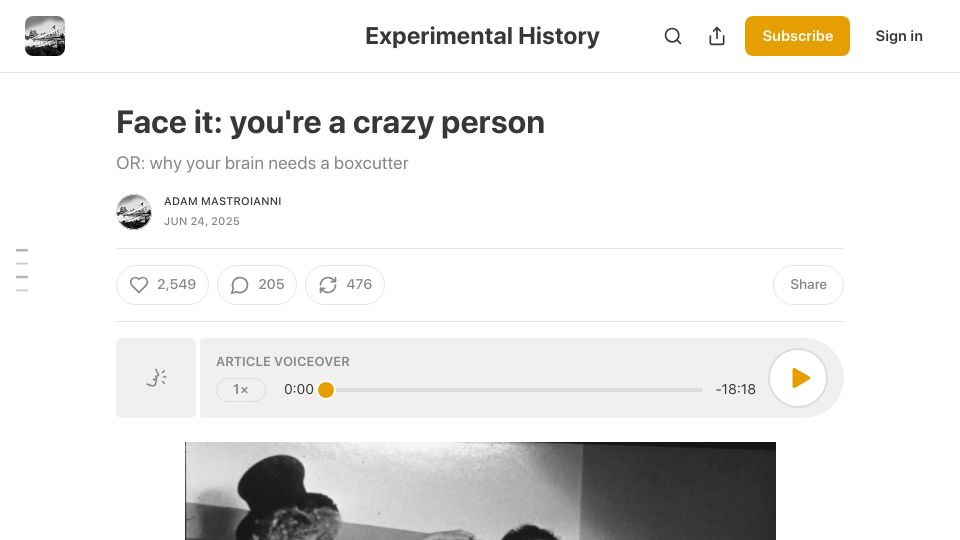
Adam Mastroianni's Experimental History essay "Face it: you're a crazy person," subtitled "why your brain needs a boxcutter."
433 points by cratermoon | 339 comments
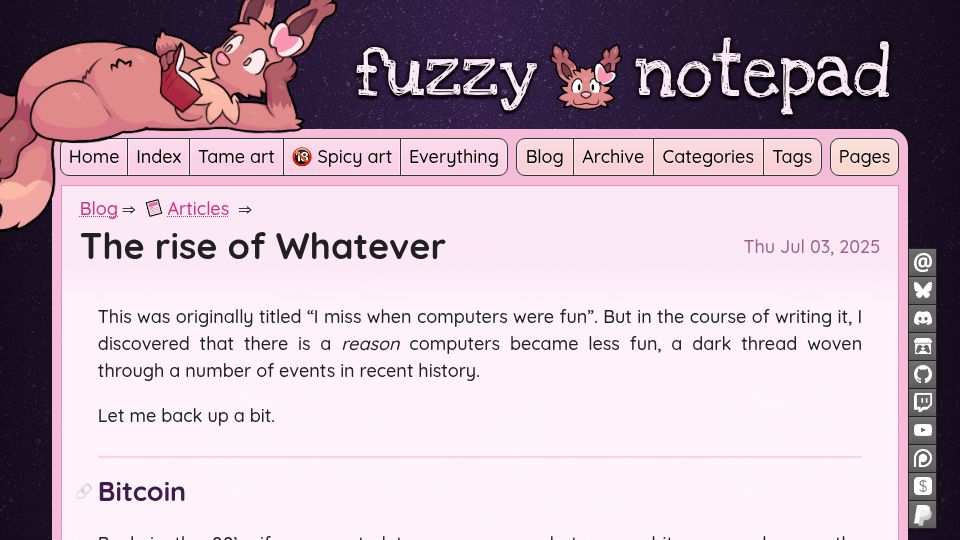
Blog essay by Eevee on fuzzy notepad arguing computers became less fun, tracing a thread through Bitcoin and later tech trends toward a culture of 'whatever'.

430 points by rkaveland | 307 comments
A blog essay by Robin Kåveland using a library metaphor to critique how modern websites and the internet push ads and distractions on visitors.

627 points by mooreds | 591 comments
A Substack essay by Brad Montague titled "Librarians are dangerous"; the captured page shows only a Substack error message.
328 points by c1ccccc1 | 110 comments
A LessWrong linkpost of Hastings' personal essay "Playing in the Creek," which starts from childhood memories of damming a backyard creek.

1681 points by smnrg | 1220 comments
An essay on simone.org arguing for and exploring the consequences of making advertising illegal.
351 points by surprisetalk | 117 comments
An essay on The Autodidacts blog arguing that troubleshooting, systematically finding and fixing causes of unwanted system behaviour, is a domain-agnostic skill.
368 points by lis | 190 comments
John Salvatier's 2017 essay arguing, via examples like building basement stairs, that reality has hidden detail which explains why people get intellectually stuck.
365 points by yamrzou | 144 comments
Jo Freeman's 1970 essay "The Tyranny of Structurelessness" arguing that leaderless groups develop hidden informal elites, hosted on her personal site.
790 points by crbelaus | 1780 comments
Paul Graham's January 2025 essay tracing the origins of wokeness as a form of priggishness, rooted in 1980s political correctness.
473 points by memalign | 81 comments
Allen Pike's short essay using a Teller magic trick to illustrate how spending an unreasonable amount of time on something can create magic.

490 points by dabacaba | 98 comments
A blog post by Ploum titled "My Colleague Julius", an essay-style story about a coworker, illustrated with a figure working at a desk.
389 points by surprisetalk | 315 comments
Personal essay arguing that individualized care, illustrated by social workers raising four orphaned children one-to-one, cannot be scaled efficiently.
563 points by yarapavan | 223 comments
An essay by Kurt Armstrong in Comment magazine on the slow, hard, good work of staying put and repairing one's place and community.
375 points by conanxin | 229 comments
Plain-text copy of Neal Stephenson's 1999 essay on operating systems, graphical interfaces, and the command line, hosted on a Stanford course site.
535 points by janchorowski | 281 comments
Peter Norvig's classic essay arguing that becoming a skilled programmer takes about ten years of deliberate practice, not 24 hours or 21 days.
382 points by brandonlc | 160 comments
An essay by Katie Zakrzewski in Isonomia Quarterly on life lessons drawn from people at the end of their lives.

422 points by InsiderTesla | 286 comments
Nikita Prokopov's blog essay lamenting slow, bloated, inefficient modern software and the industry's tolerance of poor quality.

444 points by cal85 | 164 comments
James Somers' 2015 blog essay arguing that working quickly matters more than it seems; the page loaded as a 500 server error.